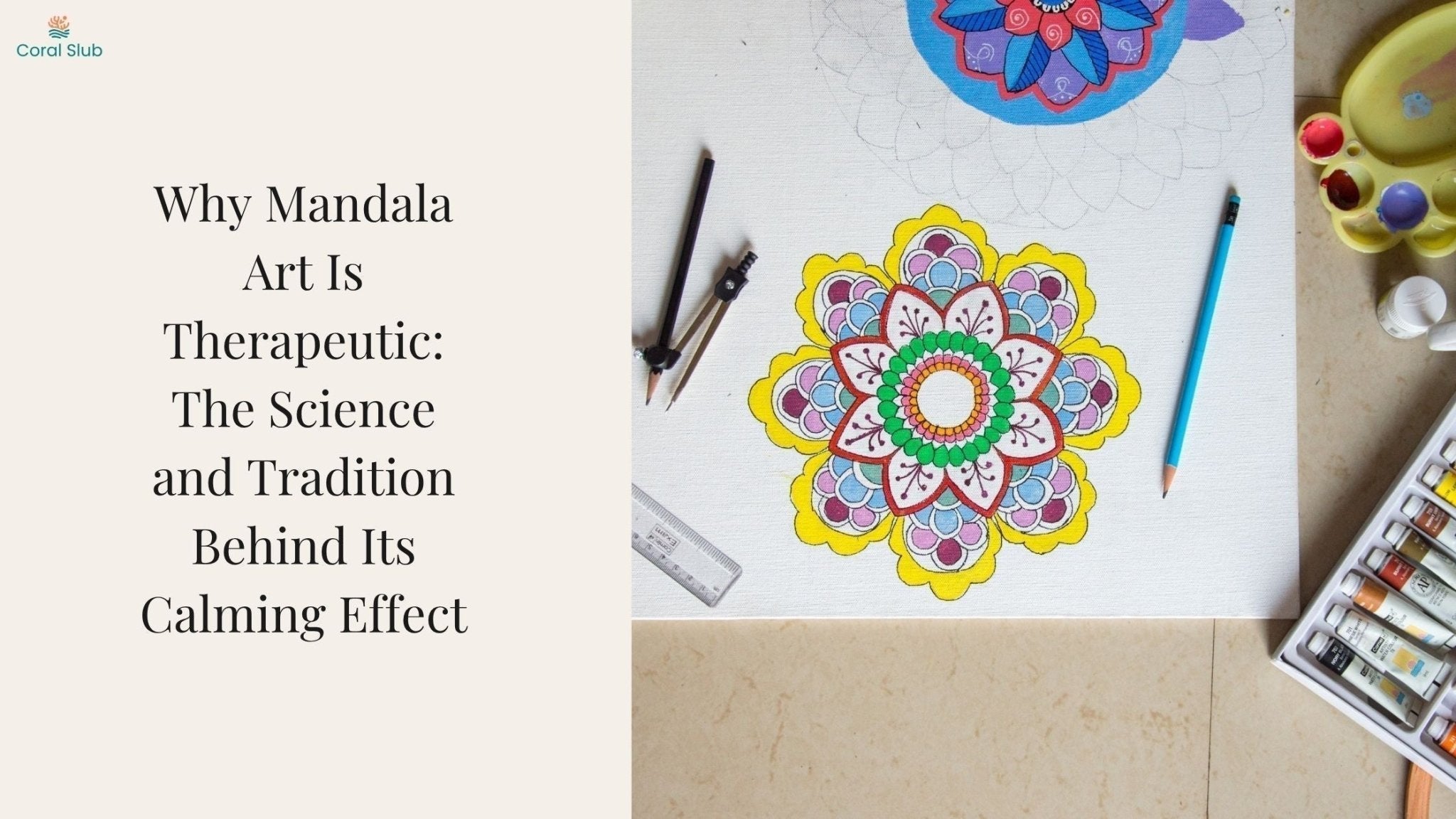
Somewhere between ancient Indian wisdom and modern psychology, the same truth has been discovered twice.
For centuries, Indian traditions have understood that drawing, observing, or meditating on a mandala has the ability to quiet the mind. Today, therapists and neuroscientists are reaching the same conclusion, supported by research and measurable outcomes.
The mandala is not only visually appealing. It has a real and noticeable impact on how we process stress, attention, and emotional balance.
What Happens in Your Brain When You Focus on a Mandala
Activation of the Relaxation Response
When the mind engages with a mandala, it is drawn into a structured visual experience. The symmetry and repetition offer a gentle path for attention to follow.
As the eye moves inward toward the centre, breathing naturally slows down. The body begins to shift away from a state of alertness and into a state of calm.
This process activates the parasympathetic nervous system, the part of the body responsible for rest and recovery. It is the same system engaged during meditation and deep relaxation.
What makes mandalas unique is that they guide the mind into this state without requiring prior training. The structure of the pattern does the work.
Reduction of Mental Overload
A restless mind often jumps between thoughts without direction. Mandalas provide a contained visual framework that reduces this mental scattering.
The repetition of shapes and patterns creates predictability, which helps the brain feel safe and grounded. This reduces cognitive overload and allows attention to stabilise.
In simple terms, the mandala gives the mind somewhere to rest.
The Traditional Roots of Mandala Therapy
Mandalas in Indian Spiritual Practice
Long before modern psychology explored these effects, mandalas were used in Indian spiritual traditions as tools for concentration.
In yogic and Hindu practices, mandalas served as focal points for dharana, the stage of meditation where the mind learns to hold attention steadily. The purpose was not decoration, but discipline of awareness.
The structure of the mandala allowed the mind to move from distraction toward stillness in a natural and guided way.
Carl Jung and the Psychological Perspective
In the twentieth century, Carl Jung encountered mandalas while studying symbols across cultures. During a period of personal introspection, he began drawing mandalas himself.
He observed that the process brought clarity and restored a sense of internal balance. Jung later described the mandala as a representation of the self and saw its creation as a way of integrating fragmented thoughts and emotions.
What is notable is the convergence of insight. Ancient traditions and modern psychology, working independently, arrived at the same understanding.
Who Benefits from Mandala Art
A Universal Tool for Stress Relief
The therapeutic effect of mandalas is not limited to a specific group. Its impact is widely accessible.
For students and teenagers, engaging with mandalas can help reduce academic stress while improving concentration. For working professionals, even short periods of interaction with mandala patterns can lower anxiety levels and create mental clarity.
In more sensitive phases of life, such as pregnancy, the calming visual structure helps redirect attention away from worry and toward the present moment. For older adults, mandalas support cognitive engagement while offering relief from repetitive thought patterns.
What makes mandalas effective is their simplicity. They do not demand skill or effort. They only require attention.
Mandala Art in Everyday Living Spaces
Bringing Calm into Daily Environments
The benefits of mandalas are not limited to active practice. They can also be experienced passively through the spaces we inhabit.
When mandala patterns are present in a home, on a cushion, a wall, or a dining table, they subtly influence the environment. The eye naturally returns to them during moments of pause, creating small but meaningful instances of calm throughout the day.
This is particularly effective in spaces where we spend time unwinding, such as living rooms or bedrooms.
The Role of Repetition and Placement
The effectiveness of mandala patterns in home décor lies in their placement and integration.
When used in soft furnishings such as cushion covers, they add visual structure without overwhelming the space. When incorporated into table linen, they anchor the setting and create a sense of balance.
The key is not excess, but presence. A single well-placed mandala pattern can be more impactful than multiple competing elements.
Why Mandala Décor Is More Than Aesthetic
Mandala-based home décor is often perceived as a stylistic choice. In reality, it functions as a subtle tool for emotional well-being.
Incorporating mandalas into everyday objects introduces moments of visual stillness into daily routines. These moments may seem small, but over time, they contribute to a more balanced and calming environment.
This is where design begins to move beyond appearance and into experience.
Final Thoughts
The therapeutic effect of mandala art is not accidental. It is rooted in both ancient understanding and modern science.
It works because it aligns with how the human mind seeks order.
It calms because it provides structure without force.
It endures because it speaks to something fundamental.
This blog is part of an ongoing series of mandalas.
The first part explored what a mandala is, its meaning, and its origin. This second part focuses on why it works and how it affects the mind.
Understanding both brings greater depth to how you experience it.
In a world filled with constant stimulation, the mandala offers something rare. A simple, accessible way to return to stillness.
Not through effort, but through attention.