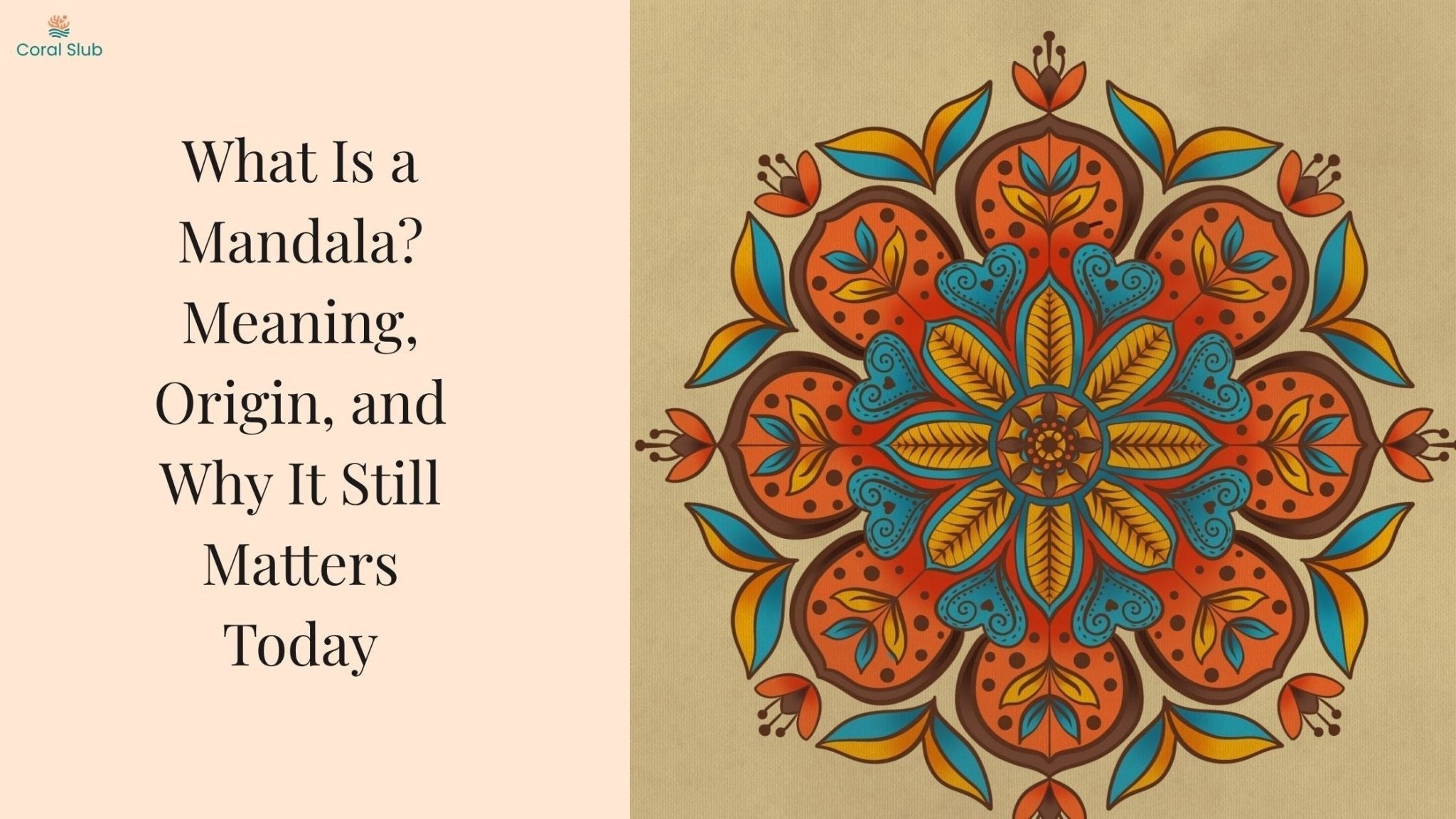
Some patterns refuse to disappear. The mandala has been drawn, carved, woven, and painted across India for over three thousand years. It has appeared on temple ceilings, in meditation halls, on sacred manuscripts, and today, on the walls and cushions of modern homes. Despite its widespread presence, the true meaning of the mandala is often overlooked.
To understand why it continues to resonate, it is important to look beyond its visual appeal and understand the philosophy it represents.
The Meaning of Mandala
A Simple Word with a Deeper Philosophy
The word mandala comes from Sanskrit, one of the world’s oldest languages, and translates to “circle.” However, this translation only begins to explain its significance.
In Indian philosophy, the circle is not a simple shape. It represents completeness, continuity, and the cyclical nature of life and the universe. It has no beginning and no end, making it a powerful symbol of wholeness.
A mandala takes this philosophical idea and transforms it into a visual structure. It gives form to a concept that is otherwise abstract, allowing it to be experienced rather than simply understood.
What a Mandala Actually Represents
The Role of the Bindu
At the centre of every mandala lies a point known as the bindu. This point represents origin, stillness, and the source of all creation. It is from this centre that the entire design unfolds.
Surrounding the bindu are layers of patterns that radiate outward in a structured and symmetrical manner. These patterns often include geometric forms, floral motifs, and repeating shapes, each contributing to the overall balance of the design.
A Visual Map of the Universe
A mandala is not created randomly. Its structure reflects a deeper order.
The centre represents the self or the divine, while the outer layers represent the external world. The visual journey from the outer edges toward the centre mirrors an inward journey of focus, awareness, and clarity.
This is why mandalas are often associated with meditation. They are not just seen, but experienced. They guide attention inward, creating a sense of calm and alignment.
The Origin of Mandalas in India
Roots in the Vedic Period
The origins of mandalas can be traced back to the Vedic period, around 1500 BCE. During this time, circular diagrams were used in rituals and spiritual practices to represent cosmic order.
These early forms laid the foundation for what would later evolve into more complex mandala structures.
Influence on Temple Architecture
Over centuries, mandala geometry became deeply integrated into Indian architecture, particularly in temple design.
Many Hindu temples follow a concentric layout, where spaces are arranged in layers leading toward a central sanctum. This design reflects the structure of a mandala, guiding movement from the outer world toward inner stillness.
Experiencing such a space is not just architectural. It is symbolic. It mirrors the same inward journey that a mandala represents.
Expansion Across Cultures
From India, the concept of the mandala spread through Buddhist traditions to regions such as Tibet, China, and Japan. While styles and interpretations evolved, the core meaning remained consistent.
Across cultures, the mandala continued to represent the relationship between the self and the universe, maintaining its philosophical depth while adapting visually.
Why Mandalas Still Matter Today
A Response to Modern Living
The continued relevance of mandalas lies in their ability to address a timeless human need. The need for balance, clarity, and calm.
In today’s fast-paced world, visual environments often feel cluttered and overwhelming. Mandalas offer a contrast to this. Their symmetry and structure introduce a sense of order without requiring conscious effort.
They create a visual pause. A moment of stillness within a busy environment.
Psychological Significance
The appeal of mandalas is not only cultural but also psychological.
Carl Jung identified mandalas as a universal archetype. According to him, the human mind naturally creates circular patterns when seeking balance and integration. This explains why mandalas feel familiar, even when their origin is unknown to the viewer.
They resonate on a level that is both visual and emotional.
Mandalas in Modern Home Décor
Bringing Meaning into Everyday Spaces
Today, mandalas have moved from sacred spaces into everyday living environments. They are present in cushion covers, table linen, and decorative elements that form part of daily life.
What makes them effective in home décor is their ability to bring structure without rigidity. They create visual balance while remaining soft and adaptable.
The Role of Placement and Material
The impact of a mandala in a home depends on how it is used.
On a sofa, mandala cushion covers can create a focal point while maintaining harmony with the rest of the space. When arranged thoughtfully, especially in coordinated combinations, they add depth without clutter.
On a dining table, mandala patterns used in table runners help define the space. They guide the eye and anchor the setting, making the arrangement feel complete.
When paired with breathable materials such as cotton, the overall experience becomes more comfortable and practical, ensuring that the design remains suitable for everyday use.
At Coral Slub
Mandala designs have been a consistent part of Coral Slub since the beginning.
Their response has always been intuitive. People are drawn to them without needing an explanation. There is a sense of familiarity, a quiet recognition of balance.
This is what makes the mandala unique.
It does not impose itself on a space. It settles into it. It becomes part of the environment without disrupting it.
When understood more deeply, it adds another layer of meaning. The same geometry that once shaped ancient temples now exists in everyday objects within the home.
Final Thoughts
A mandala is not simply a decorative pattern.
It represents completeness and continuity.
It reflects balance and structure.
It encourages stillness and focus.
Its relevance has endured because its meaning remains unchanged.
In a world that continues to move faster, the mandala offers something rare. A sense of pause, of order, and of quiet connection. And that is precisely why it still matters today.