Cart
0
You have probably seen it countless times without even thinking about its name.That elegant, curved, teardrop-shaped motif appears on an old Kashmiri shawl, a vintage textile tucked away in a family cupboard, a richly printed saree or perhaps a cushion passed down through generations. Known in Indian textile traditions as ambi, the paisley motif has travelled across centuries, cultures and continents, evolving along the way while retaining its unmistakable identity.
For a while, paisley was often associated with vintage interiors, traditional textiles or bohemian styling. Today, however, the motif is experiencing a fresh revival. Designers are reinterpreting it through contemporary colours, cleaner compositions and more versatile applications.
And perhaps home décor is where its return feels most natural.After all, Indian homes have always understood the power of a beautiful textile. A cushion can add colour to a sofa, a table runner can transform a dining table, and a thoughtfully printed fabric can bring an entire room together.
Paisley does not need to look old-fashioned. It simply needs to be styled with intention.
What Is Paisley? Understanding the Ambi Motif

From Indian Textile Heritage to a Global Design Icon
Paisley is recognised by its distinctive curved, teardrop-like form. In Indian textile traditions, the motif is often known as ambi, while the name "paisley" became associated with the pattern through its later popularity in European textile production.
Its story is one of cultural exchange.
The motif has deep connections with Persian artistic traditions and became particularly prominent in Indian textiles, including the luxurious Kashmiri shawls that eventually travelled to Europe. European textile manufacturers later adopted and reproduced the design, helping transform paisley into an internationally recognised textile pattern.
Why Has the Motif Survived for So Long?
Perhaps because it is incredibly adaptable.The curved form can be delicate or dramatic, intricate or minimal, symmetrical or organic. It can be filled with flowers, leaves and fine detailing or reduced to a simple contemporary outline.That flexibility allows paisley to move effortlessly between traditional Indian textiles and modern interiors.
From Kashmiri Shawls to Contemporary Homes

A Motif That Has Never Really Disappeared
Paisley has travelled an extraordinary distance.What began as a culturally significant motif within Persian and Indian textile traditions eventually became popular across Europe, particularly through Kashmiri shawls. It later found another identity in twentieth-century fashion and counterculture.
Today, designers continue to reinterpret the motif rather than simply reproducing its historical versions. The original visual language remains recognisable, but its treatment keeps changing.
This ability to evolve is exactly what makes paisley relevant to modern Indian home décor.
It can look traditional when paired with rich colours and intricate detailing. But placed against a neutral sofa, natural wood or a contemporary interior, the same motif can feel remarkably modern.
Why Paisley Is Returning to Design

The Revival of Heritage-Inspired Patterns
One reason paisley feels relevant again is the renewed appreciation for heritage, craftsmanship and patterns with a story.
Contemporary design is increasingly making room for objects that feel connected to culture rather than completely detached from it.Instead of choosing décor purely because it is minimal or fashionable, homeowners are increasingly looking for pieces with character.Paisley fits naturally into this shift.
The New Approach to Traditional Patterns
The modern interpretation is not necessarily about covering an entire room in paisley.It is about using the motif thoughtfully.A single paisley cushion can introduce pattern to a neutral sofa. A pair of cushions can create symmetry. A paisley-inspired table runner can bring a subtle heritage influence to the dining room.This maximal pattern, minimal application approach keeps the motif feeling fresh rather than overwhelming.
Paisley Cushion Covers: The Easiest Way to Introduce the Motif

Start Small With Soft Furnishings
If you are hesitant about bringing a strong traditional pattern into your home, cushion covers are one of the easiest places to begin.Unlike wallpaper, upholstery or large-scale artwork, cushions can be changed whenever your mood or décor changes.
Style Paisley Cushions on a Neutral Sofa
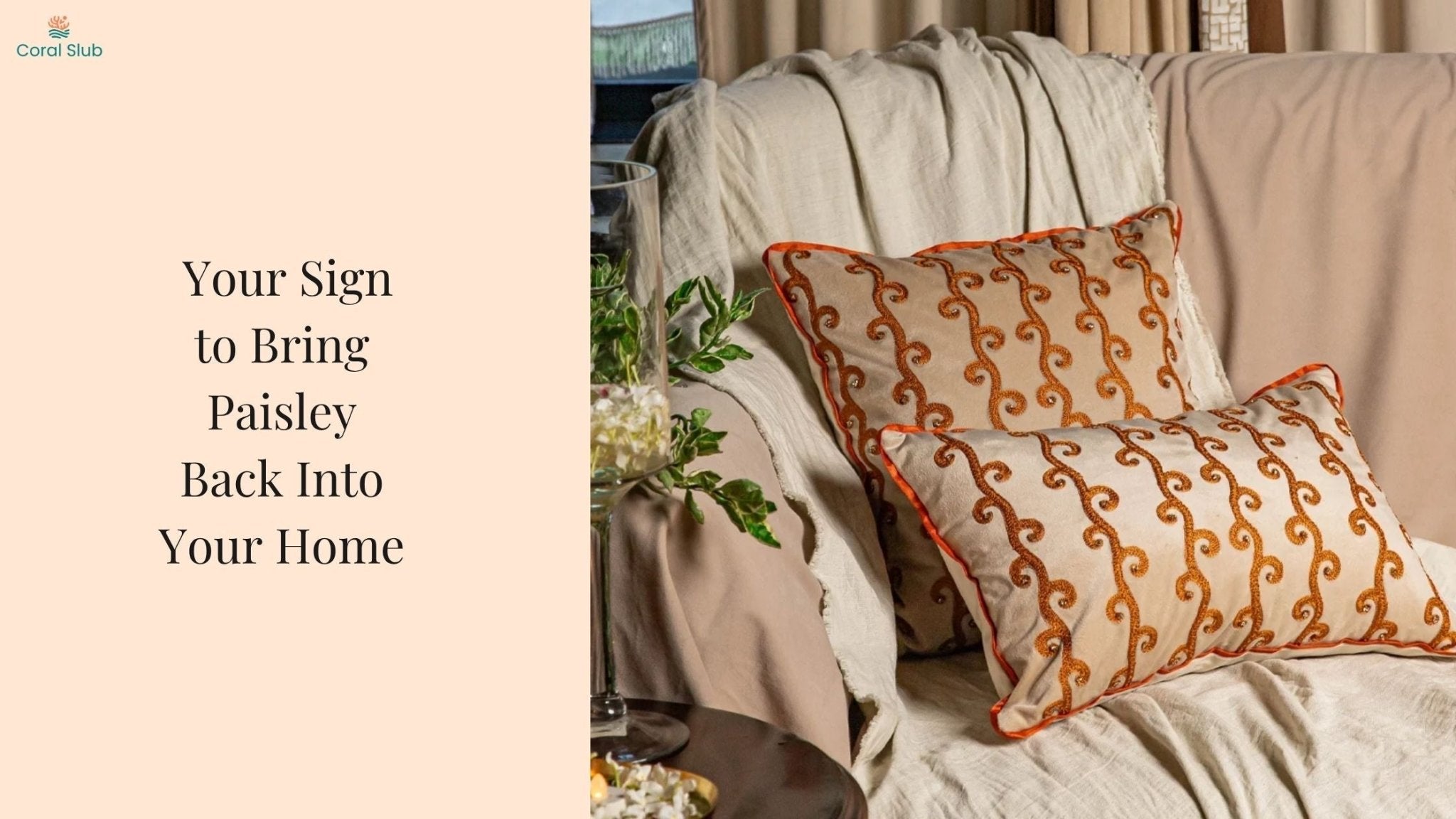
A neutral sofa creates an excellent backdrop for a patterned cushion.Think ivory, beige, natural linen or soft grey paired with a paisley cushion in earthy terracotta, indigo, mustard, olive or deep red.The contrast allows the pattern to become a focal point without taking over the room.
Mix Paisley With Other Indian Motifs
Paisley does not need to stand alone.It can be combined with floral prints, geometric patterns, block prints or embroidered textiles as long as there is some connection through colour.
For example, a paisley cushion in terracotta can be paired with a smaller floral cushion featuring the same warm tone.The result feels collected rather than perfectly matched.
Paisley in the Living Room

Turn a Familiar Space Into a More Characterful One
The living room is perhaps the most natural place to experiment with Indian-inspired paisley décor.It is a space where textiles, artwork, furniture and accessories can interact freely.
Create a Layered Indian Interior
Imagine a neutral sofa layered with paisley cushion covers, a handcrafted rug underneath, a wooden coffee table and a few brass accents.Nothing needs to look excessively traditional.The paisley provides the cultural connection, while the surrounding materials keep the space contemporary.This is particularly effective in modern Indian homes where architectural simplicity can provide a backdrop for richer patterns.
Paisley in the Bedroom

Bring the Motif Into a More Relaxed Setting
The bedroom calls for a softer approach.Instead of choosing a large, heavily detailed paisley print, look for versions with a restrained colour palette or smaller-scale motifs.
Pair With Natural Textures
Cotton, linen, wood and other natural textures can soften the visual richness of paisley.A paisley cushion placed against plain bedding can introduce just enough pattern to make the room feel layered.For a more traditional Indian aesthetic, combine the motif with warm wooden furniture and handcrafted accents.For a contemporary bedroom, pair it with white or neutral bedding and keep the rest of the room understated.
Paisley for the Dining Table

Turn Heritage Into Everyday Ritual
The dining table is another beautiful place to introduce Indian textile motifs.A paisley-inspired table runner can instantly create a visual centre for the table without requiring a complete makeover.
Place it over a plain wooden or neutral table and allow the pattern to provide the colour.
Style It for Everyday Meals or Festive Gatherings
The same runner can work for a weekday family dinner as well as a festive gathering.Add simple ceramics, brass serveware or fresh flowers to create an inviting Indian tablescape.The result is not overly formal. Instead, it feels warm, personal and connected to Indian textile traditions.
Paisley and Indian Craftsmanship

Why the Motif Works So Well With Handmade Textiles
Paisley has always had a strong relationship with textiles.That makes it particularly compatible with India's rich traditions of printing, weaving and embroidery.
A paisley design can be interpreted through block printing, embroidery, weaving, quilting and hand-painted textile techniques, giving the same motif completely different personalities.
The Beauty Is in the Imperfections
When a traditional motif appears on a handcrafted textile, slight variations can make each piece feel individual.The print may not be perfectly uniform. The embroidery may show the rhythm of the artisan's hand.These qualities add warmth to the home in a way that mass-produced decorative objects often cannot.
Paisley as More Than a Trend

A Pattern With a Story
Calling paisley a "trend" almost feels incomplete.Fashion may rediscover it. Interior designers may reinterpret it. Contemporary brands may give it new colours and applications.But the motif itself has already travelled through generations.Its continued relevance comes from that history.
The paisley pattern carries traces of Indian textile heritage, craftsmanship, cultural exchange and changing ideas of design.That gives it a depth that purely seasonal patterns often lack.
Final Thoughts

Paisley has travelled a remarkable journey, from the ambi motif and Persian artistic traditions to Kashmiri shawls, European textiles and contemporary design.
Its continued appeal lies in its ability to evolve.It can be intricate or minimal, traditional or contemporary, colourful or understated. Most importantly, it carries a story.
For Indian homes, bringing paisley back does not mean returning to a particular era of décor.It means rediscovering a familiar piece of India's textile heritage and giving it a place in the way we live today.Start with one cushion.Add a table runner.Pair it with a neutral sofa, natural wood or contemporary artwork.Let the pattern become part of the room rather than the entire room.Because some designs do not really go out of style. They simply wait for us to see them differently.And perhaps it is time to bring ambi back home.
Frequently Asked Questions
1.What is the Indian name for paisley?
The paisley motif is traditionally known in Indian textile contexts as ambi, referring to its characteristic curved, teardrop-like form. The motif has deep cultural connections and became particularly prominent in Indian textiles such as Kashmiri shawls.
2.Is paisley an Indian pattern?
Paisley's history is interconnected with Persian and Indian textile traditions. It became particularly prominent in Kashmir and later travelled to Europe through the trade in Kashmiri shawls, where European textile manufacturers adopted and reproduced the motif.
3.How can I use paisley in home décor without making my home look old-fashioned?
Use paisley selectively. Pair a patterned cushion or table runner with neutral furniture, clean silhouettes and contemporary accessories. Modern colour combinations can also make the traditional motif feel fresher.
4.What colours work best with paisley home décor?
Terracotta, indigo, mustard, olive, ivory, beige, rust and muted pink can work particularly well in Indian-inspired interiors. The best choice depends on the colours and materials already present in your room.