Cart
0
Every year, when Ganpati Bappa comes home, the atmosphere changes almost instantly. Homes are cleaned and decorated, flowers arrive in abundance, diyas are lit, modaks are prepared, and the familiar sound of aarti becomes part of everyday life. For many families, Ganesh Chaturthi is not simply a festival on the calendar. It is a period of devotion, togetherness, celebration and renewal.
But there is another way to think about bringing Bappa home.
What if the celebration itself could reflect the values of care, respect and harmony with nature?
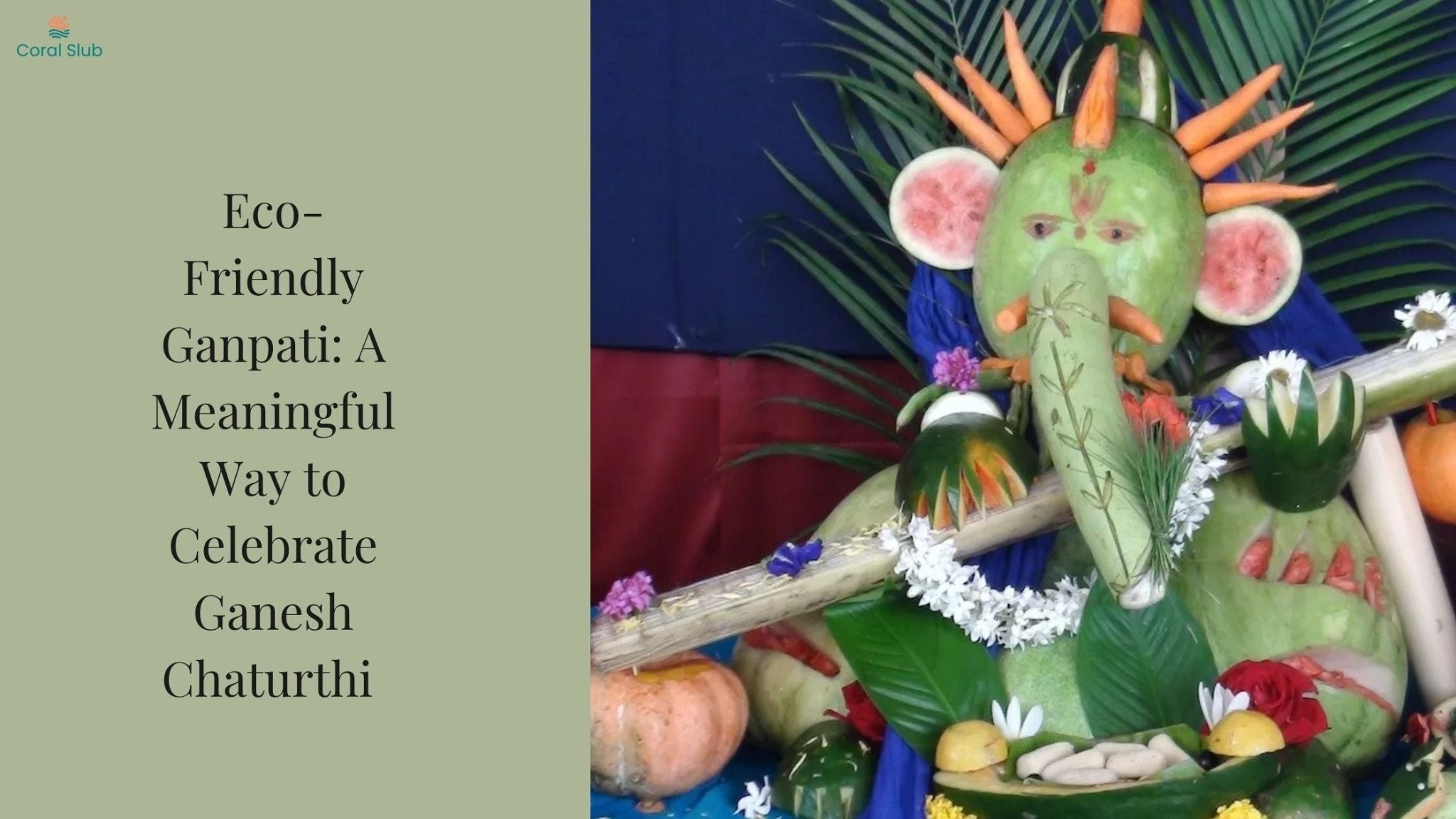
This is where the idea of an eco-friendly Ganpati becomes meaningful. Sustainable Ganesh Chaturthi does not require giving up the traditions that make the festival special. Instead, it invites us to reconsider the materials we use, the way we decorate our homes, the size and composition of the idol we choose, and what happens when the festival comes to an end.
In 2026, this conversation is particularly relevant. Maharashtra Tourism describes Ganesh Chaturthi not only as a religious and cultural celebration but also as a festival increasingly associated with environmental awareness. It highlights the traditional use of shadu clay and natural colours and the growing emphasis on smaller, eco-friendly idols that can reduce harm to water bodies.
The idea, therefore, is not to make Ganpati less festive.It is to make the celebration more thoughtful.
What Does Eco-Friendly Ganpati Actually Mean?

An eco-friendly Ganpati generally refers to an idol and celebration designed to minimise environmental impact, particularly during visarjan.
The material used to make the idol matters because the idol eventually has to be immersed or otherwise respectfully returned according to the chosen tradition and local arrangements. Traditional clay has long been associated with Ganpati idols, while the widespread use of materials such as Plaster of Paris and certain synthetic paints has raised environmental concerns because of their behaviour in water.
The Central Pollution Control Board has noted that idols made from materials including Plaster of Paris, plastic and cement, along with inorganic paints and colours, can contribute to deterioration of water quality when immersed.This is why the choice of idol is more than an aesthetic decision.It is also an environmental one.
Why Choose a Clay Ganpati Idol?

The return to clay is not simply a modern sustainability trend. It has a connection with the traditional understanding of Ganpati idol-making.
Maharashtra Tourism notes that Ganpati idols were traditionally made from shadu clay and natural dyes, while contemporary eco-friendly celebrations increasingly encourage clay idols, natural colours and smaller sizes.Maharashtra Pollution Control Board guidance has also examined the behaviour of different idol materials during immersion, noting that Plaster of Paris idols do not readily disintegrate in water, while shadu clay idols disintegrate considerably faster under the conditions of the cited experiment. The guidance also recommends natural materials and encourages consideration of recyclable or reusable alternatives.That makes the material of the idol an important starting point for a more conscious celebration.
What should you look for?
When selecting a Ganpati idol, consider:
- Natural clay or shadu clay
- Natural or environmentally appropriate colours
- Minimal synthetic embellishments
- Smaller, manageable dimensions for home worship
- A clearly stated material composition from the artisan or seller
The key is to ask questions rather than assuming that every idol labelled "eco-friendly" is automatically environmentally responsible.
Why Does Ganpati Visarjan Matter Environmentally?

Visarjan is one of the most emotional parts of Ganesh Chaturthi. After days of worship, devotees accompany Bappa for his farewell, carrying the idol with music, aarti and the familiar cry of Ganpati Bappa Morya.At the same time, immersion is the point at which the materials used to make and decorate the idol can enter a water system.
CPCB research explains that when painted idols are immersed, certain inorganic colours and materials can dissolve or degrade water quality. The board's revised immersion guidelines therefore emphasise measures such as designated immersion locations, segregation of biodegradable and non-biodegradable materials, and temporary or artificial immersion facilities where appropriate.This is why an eco-friendly Ganpati should not be viewed only as an idol made from clay.Sustainability needs to continue through visarjan too.
Eco-Friendly Visarjan: Completing the Celebration Responsibly

For families celebrating Ganpati at home, one option recommended in CPCB material is immersion in a bucket or tub rather than directly in a public water body, where appropriate. It also discusses permanent idols with symbolic immersion and reuse as another possible approach.
However, immersion practices and local restrictions can vary, so devotees should follow the instructions of their municipal authority and local pollution-control authorities.The larger principle is simple: avoid treating natural rivers, lakes and ponds as places where festival waste can simply be discarded.
Flowers, decorative materials, plastic, thermocol and other non-biodegradable elements should be separated rather than immersed with the idol. It revised guidelines specifically call for segregation of biodegradable and non-biodegradable waste around immersion sites.A respectful farewell to Bappa can therefore also be a respectful gesture towards the environment.
Eco-Friendly Ganpati Decoration Ideas for Your Home

Choosing a sustainable idol is only one part of the celebration. The decoration around Bappa can also become an opportunity to rethink how we use materials.The most beautiful sustainable decorations are often those that feel naturally connected to an Indian home: flowers, leaves, cotton textiles, brass diyas, clay lamps, wooden objects and handcrafted elements.
Instead of creating an elaborate backdrop from plastic, thermocol and single-use materials, consider creating a setting that can be reused or naturally returned to the earth.
Use Flowers and Foliage
Marigolds, jasmine, roses, mango leaves and other locally available flowers and foliage can instantly create a festive atmosphere.A simple floral arrangement can often feel more elegant than a heavily decorated backdrop, particularly when the idol itself is the visual centre of the space.After the festival, flowers can be separated and composted where local facilities or home composting make that possible.
Bring in Natural Materials
An eco-friendly Ganpati corner can incorporate:
-
Brass diyas
-
Clay lamps
-
Wooden décor
-
Cane baskets
-
Fresh flowers
These materials also create a warmer aesthetic than disposable plastic decoration.The result is a festive corner that feels rooted rather than excessive.
Use Textiles for a Beautiful Reusable Ganpati Backdrop

One of the easiest ways to create a sustainable Ganpati decoration is to replace a disposable backdrop with fabric.A beautiful cotton textile can be draped behind the idol, used as a table covering, or layered into the pooja setting. After Ganesh Chaturthi, the same textile can return to everyday life instead of being thrown away.
This is where traditional Indian textiles become particularly relevant.Hand block prints, floral motifs, paisleys, geometric borders and other Indian textile patterns naturally complement the warmth of a Ganpati celebration. A printed cotton runner can define the pooja table, while coordinated cushions or textiles can bring the festive colour palette into the rest of the room.
For a brand like Coral Slub, this creates a natural connection between sustainability and everyday décor. Reusable cotton cushion covers, block-printed textiles and table runners can contribute to a festive setting without becoming single-use festival purchases.
The idea is simple: decorate for Bappa, then continue living with the décor.
Choose Reusable Décor Over Disposable Decorations

A sustainable celebration becomes easier when decorations are designed to return year after year.Instead of buying an entirely new backdrop every Ganesh Chaturthi, consider building a small collection of versatile festive pieces that can be restyled differently each year.
A fabric backdrop can be folded and stored. Brass diyas can be reused. Wooden décor can move between rooms. Cane baskets can become storage pieces after the festival. Cotton textiles can return to the dining or living room.This approach changes the economics of festive décor too.
Rather than repeatedly purchasing decorations that have a lifespan of a few days, you invest in pieces that remain useful long after the aarti ends.
Can Sustainable Ganpati Décor Still Look Luxurious?

Absolutely.In fact, an eco-conscious Ganpati setting can often look more sophisticated because it relies on texture, material and craftsmanship rather than visual excess.Imagine a clay Ganpati placed on a wooden platform, surrounded by fresh marigolds, brass diyas and green foliage. Behind it, a beautifully patterned cotton textile creates a soft backdrop. A handcrafted table runner anchors the pooja surface while warm lighting highlights the details.
There is colour.There is texture.There is festivity.But there is also restraint.This style works particularly well in contemporary Indian homes where traditional elements are balanced with natural materials and uncluttered interiors.
Smaller Can Be More Meaningful

The size of a Ganpati idol is another consideration.Maharashtra Tourism specifically mentions smaller idols as part of the growing emphasis on eco-friendly celebrations. Maharashtra's immersion guidance has also recommended limiting the size of household idols, linking smaller idols with easier immersion and reduced material consumption.
A smaller home Ganpati does not mean a smaller celebration.It simply shifts the focus.Instead of making the idol enormous, you can make the experience around Bappa richer through flowers, aarti, family traditions, handmade décor, music, food and time spent together.
Eco-Friendly Ganpati Is Not About Doing Less
There is sometimes a misconception that an environmentally conscious celebration must be simpler, smaller or less beautiful.
It does not.It simply asks us to celebrate differently.A handmade clay idol can be just as beautiful as a heavily embellished one. Fresh flowers can be more beautiful than plastic garlands. A hand-printed cotton textile can create a more elegant backdrop than a disposable one. Brass diyas can replace decorative plastic lighting and continue to be used for years.
And perhaps most importantly, these choices bring us closer to the idea of celebrating with intention. Ganesh Chaturthi is a festival of devotion, culture, unity and environmental awareness, reflecting the growing understanding that celebration and care for nature do not need to be separate values.
Ganpati 2026: Celebrating Bappa with a Lighter Footprint

For Ganesh Chaturthi 2026, the festival falls on Monday, 14 September, with celebrations continuing according to individual and community traditions. The season offers an opportunity to think about what we carry forward from one year to the next.
Perhaps that can be more than a decoration or a tradition.Perhaps it can be a habit.Choosing clay.Choosing reusable textiles.Choosing natural materials.Choosing responsible visarjan.Choosing to create less waste.Choosing to celebrate with greater awareness.Because sustainability does not take away from devotion.It can become an expression of it.
Bringing Bappa Home, Thoughtfully

The most meaningful Ganpati celebrations are often remembered not because of how much was used to decorate them, but because of how they made people feel.
The excitement of bringing Bappa home.The fragrance of flowers.The sound of aarti.The first modak.The family gathered around the pooja space.The farewell that comes too soon.
An eco-friendly Ganpati simply adds another layer to that experience: the understanding that while we welcome Ganesha into our homes, we can also remain mindful of the world outside them.A clay idol, a reusable textile backdrop, fresh flowers, handcrafted décor and a responsible visarjan can turn sustainability from a trend into a tradition.
This Ganesh Chaturthi, let Bappa come home with devotion, beauty and a little more thought for the earth.
Ganpati Bappa Morya.
Pudhchya Varshi Lavkar Ya.
Frequently Asked Questions
1.What is an eco-friendly Ganpati?
An eco-friendly Ganpati generally refers to an idol made using environmentally considerate materials, particularly natural clay, combined with responsible choices around colours, decorations and immersion.
2.Is a clay Ganpati better than a Plaster of Paris idol?
Clay idols are generally considered more environmentally suitable for immersion than Plaster of Paris idols because PoP does not readily disintegrate in water. CPCB and Maharashtra environmental guidance have encouraged natural or environmentally appropriate materials for idols.
3.How can I decorate my Ganpati at home sustainably?
Use fresh flowers, foliage, brass diyas, clay lamps, wooden elements and reusable cotton textiles. Fabric backdrops and table runners can replace disposable thermocol or plastic decorations and can be used again after the festival.
4.How can I make Ganpati visarjan eco-friendly?
Follow your local authority's immersion instructions and use designated immersion facilities where required. For suitable household celebrations, material also discusses immersion in buckets or tubs rather than public water bodies.