
Cart
0
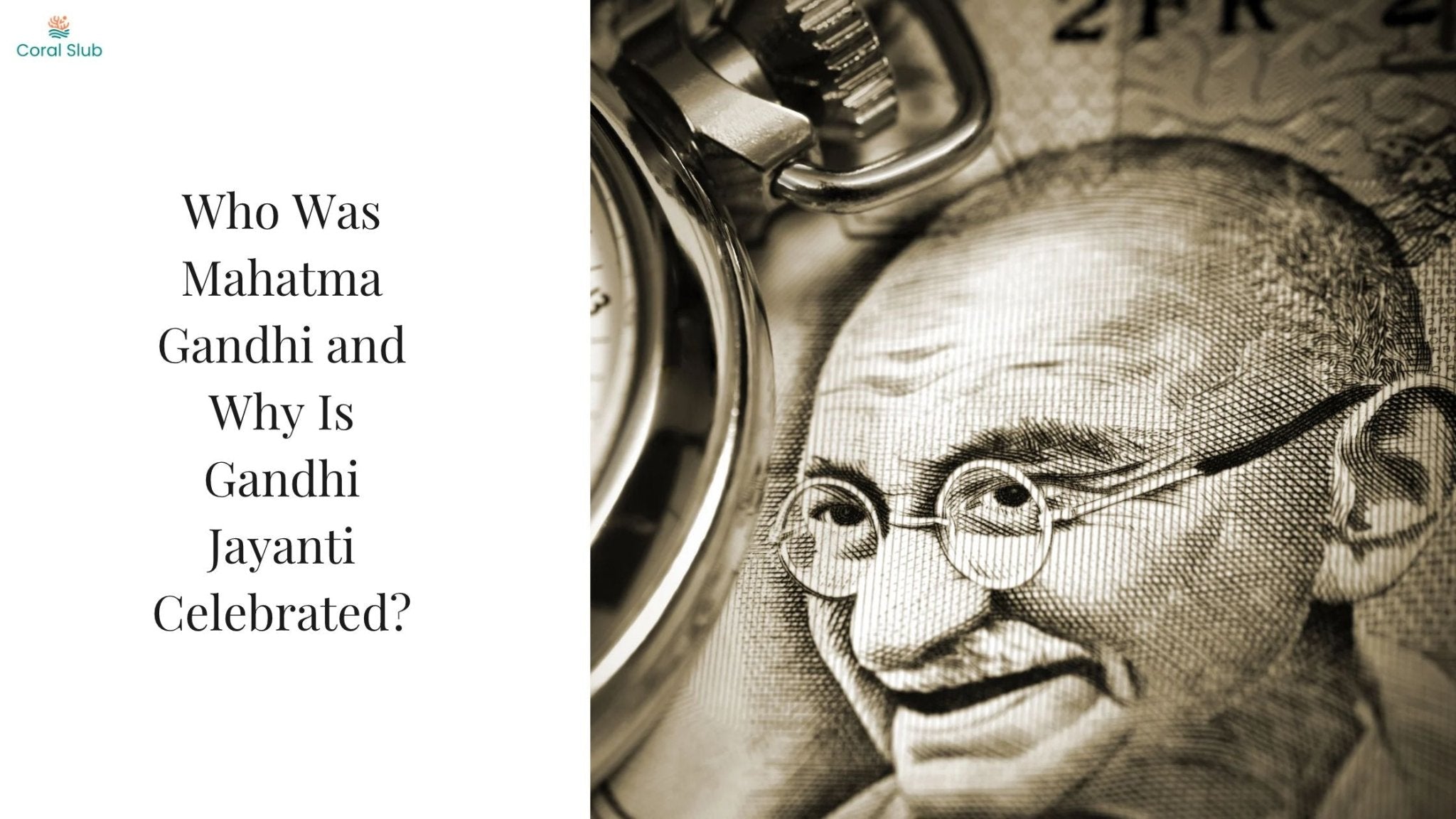
Every year on 2 October, India observes Gandhi Jayanti, marking the birth anniversary of Mohandas Karamchand Gandhi, widely known as Mahatma Gandhi. Born on 2 October 1869 in Porbandar, Gujarat, Gandhi became one of the most prominent leaders of India's independence movement and is internationally associated with the principles of non-violence and peaceful resistance.
Gandhi Jayanti is not only a day to remember an important figure in India's history. It is also an occasion to reflect on ideas such as non-violence, truth, peace and social responsibility. The United Nations also observes 2 October as the International Day of Non-Violence, following a General Assembly resolution adopted in 2007.
Who Was Mahatma Gandhi?
Gandhi's Early Life and Education

Mohandas Karamchand Gandhi was born on 2 October 1869 in Porbandar, in present-day Gujarat. He studied law in London and later travelled to South Africa to work as a lawyer.
His years in South Africa became an important period in the development of his approach to social and political resistance. He experienced racial discrimination there and began developing methods of challenging injustice through organised non-violent resistance.
After returning to India, Gandhi became increasingly involved in the country's political and social movements and eventually emerged as a major leader of the Indian National Congress.
Gandhi and India's Freedom Movement

Gandhi played a significant role in India's struggle against British colonial rule. Rather than advocating armed resistance, he promoted satyagraha, a form of resistance based on truth, non-violence and civil disobedience.
He encouraged people to participate in mass movements and challenge unjust colonial laws through peaceful action. One of the most recognised examples was the Salt March of 1930, when Gandhi and his followers marched to the coastal village of Dandi to challenge the British salt laws. The movement became an important episode in the wider independence struggle.
Gandhi was also associated with the Quit India Movement of 1942, which called for an end to British rule in India. His political work was closely connected with broader movements involving many other leaders, organisations and ordinary citizens who participated in the freedom struggle.
Gandhi's Belief in Non-Violence

Non-violence was central to Gandhi's political philosophy. For him, resistance to injustice did not have to involve physical violence or hatred towards opponents.
The United Nations describes Gandhi as a pioneer of the philosophy and strategy of non-violence and notes that his approach inspired civil rights and social-change movements around the world.
His ideas continue to be discussed internationally because they connect political resistance with principles of peace, dignity and dialogue.
Gandhi's Work Beyond the Freedom Movement

Gandhi's public life extended beyond India's struggle for independence. He spoke about social equality, religious harmony and the dignity of marginalised communities. He also advocated for changes in social practices and encouraged people to take responsibility for their communities.
His approach to politics was therefore closely connected with his broader ideas about how individuals should live and how society should respond to injustice.
At the same time, Gandhi's legacy is historically complex and has been interpreted and debated in different ways. Understanding Gandhi's place in Indian history requires looking at both his influence on the independence movement and the wider debates surrounding his ideas, actions and political positions.
Why Is Gandhi Jayanti Celebrated on 2 October?

Gandhi Jayanti is observed on 2 October because it is Gandhi's date of birth. The day provides an opportunity in India to remember his contribution to the independence movement and reflect on the principles associated with his life.
Schools and institutions commonly mark the occasion through educational programmes, speeches, discussions and activities focused on Gandhi's life and the idea of non-violence.
The day is also significant beyond India. In 2007, the United Nations General Assembly established 2 October as the International Day of Non-Violence, specifically choosing Gandhi's birthday to promote awareness of non-violent principles through education and public awareness.
Gandhi Jayanti and the Message of Non-Violence

The international observance gives Gandhi Jayanti a wider significance. The United Nations describes non-violence as a principle relevant to peace, tolerance and understanding, and continues to commemorate Gandhi's birthday through the International Day of Non-Violence.
The day therefore encourages reflection on how disagreements and conflicts can be approached without resorting to violence. Gandhi's life is remembered not simply for the historical events in which he participated, but also for the philosophy of peaceful resistance that became closely associated with his name.
How Is Gandhi Jayanti Observed?

Gandhi Jayanti is observed across India through commemorative programmes, particularly at educational institutions and public organisations. Tributes are offered at Gandhi memorials, including Raj Ghat in New Delhi, where Gandhi's cremation site is located.
Schools often use the occasion to introduce students to Gandhi's life and discuss values such as truth, non-violence, responsibility and respect for others. The day can therefore serve both as a historical remembrance and as an opportunity for civic and educational reflection.
Why Gandhi Jayanti Still Matters

Gandhi Jayanti continues to hold significance because it connects a historical event, Gandhi's birth, with a broader discussion about how societies respond to conflict and injustice.
His role in India's independence movement remains an important part of the country's modern history, while his philosophy of non-violence has also received international recognition. The United Nations continues to describe 2 October as a day to promote peace, tolerance, understanding and non-violence.
Remembering Gandhi Jayanti, therefore, is not only about remembering a person. It is also about understanding an important chapter of India's freedom struggle and reflecting on the principles that made his political philosophy influential far beyond India.
Conclusion

Gandhi Jayanti is celebrated every year on 2 October to mark the birth anniversary of Mahatma Gandhi, one of the most prominent leaders of India's independence movement. His use of non-violent resistance, his involvement in major movements such as the Salt March and Quit India Movement, and his emphasis on truth and peaceful action have made him an important historical figure in India and internationally.
The United Nations' decision to observe 2 October as the International Day of Non-Violence further reflects the global significance attached to the principles associated with Gandhi.
Gandhi Jayanti is therefore a day to remember India's history, understand Gandhi's contribution and reflect on the continuing relevance of peace, non-violence and peaceful resistance in society.