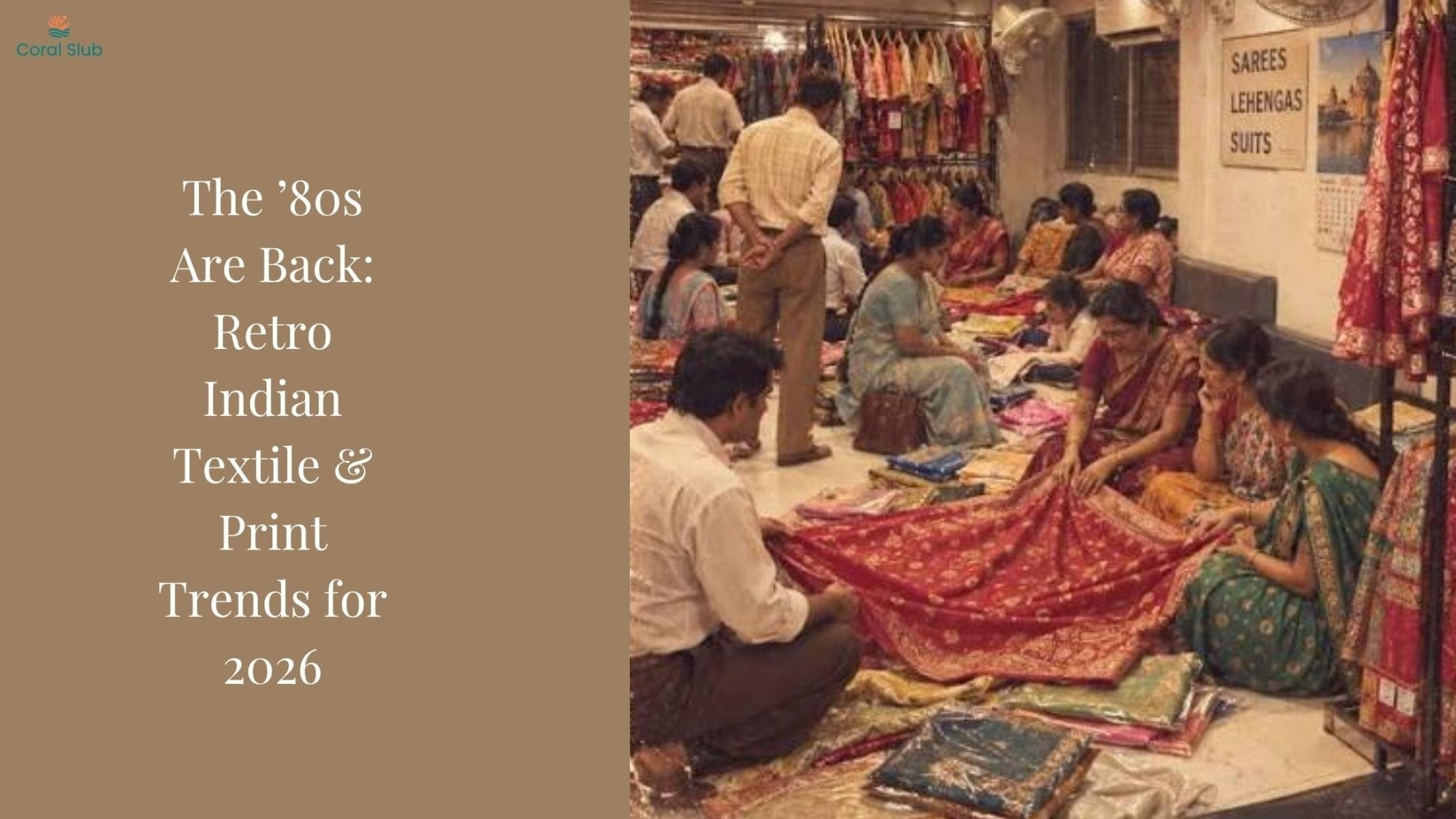
There is something unmistakable about the ’80s. It was a decade that was not afraid of colour, pattern or personality. Interiors were expressive, fashion was dramatic, and textiles were rarely content to simply blend into the background. Florals became larger, colours became richer, paisleys appeared everywhere, brocade returned to the conversation and geometric patterns brought a sense of rhythm to everything from clothing to home furnishings.
Now, decades later, that visual language is returning.But in India, the revival is taking a particularly interesting form. Rather than simply recreating Western interpretations of ’80s style, the renewed interest in retro design is intersecting with India's own textile heritage. Paisley, florals, ikat, chintz, brocade, geometric repeats and block prints are all finding relevance in contemporary design, while traditional Indian techniques such as Ajrakh, Dabu, Bagru and Sanganeri continue to be reinterpreted for today's audience. Vogue India describes these regional block-printing traditions as part of India's enduring textile heritage, with contemporary designers continuing to adapt them for modern fashion.
This makes the current revival more than a nostalgia trend.It is a reminder that many of the patterns we associate with retro design have always had a place in Indian textile culture.And in 2026, they are finding their way back into our homes in a more considered, contemporary form.
Why Are the ’80s Coming Back Now?
The return of the ’80s aesthetic comes at a time when design is moving away from spaces that feel overly restrained and towards interiors with more individuality. For several years, neutral palettes, clean lines and minimalist styling dominated contemporary homes. While that aesthetic is unlikely to disappear, there is now a stronger desire for rooms that feel collected, expressive and personal.
The renewed interest in nostalgic prints is part of this larger movement. Even contemporary 2026 fashion is revisiting colourful paisleys, florals and quilted or handcrafted-looking prints, showing that nostalgia is being translated rather than simply copied.
India is particularly well placed for this shift because our textile traditions already offer an extraordinary vocabulary of colour and pattern. A floral block print from Rajasthan, the deep geometry of Ajrakh from Kutch, the organic quality of ikat, the decorative richness of brocade or the familiar curve of a paisley can all introduce the visual exuberance associated with retro design without making a home feel stuck in another decade.
The result is a much more interesting interpretation of the trend.The ’80s are returning, but India is giving the revival its own textile language.
The Original ’80s Textile Aesthetic Was Already Fascinated by India
Interestingly, the relationship between ’80s fashion and Indian textiles has historical precedent.
A 1985 Washington Post fashion feature described the period's interest in rich jewel tones, textured natural fabrics, silks, brocades, scroll and paisley patterns, ikat variations and chintz. The article also specifically discussed an "Indian-inspired" fashion direction, with designers drawing on colours associated with saris and dhurries, paisleys, ikats and handwoven cottons.
This is an important piece of context when we talk about today's revival.Some of the patterns now being described as retro were already connected to Indian textile aesthetics decades ago. What is changing today is the way these motifs are being presented.
Instead of reproducing an entire ’80s interior, contemporary design is taking individual elements and giving them cleaner surroundings.
A paisley cushion can sit on a modern linen sofa.A bold floral bedsheet can work with a minimal bedroom.A brocade runner can bring richness to a simple wooden dining table.A geometric block print can add character to an otherwise neutral room.The pattern becomes the statement while the rest of the space gives it room to breathe.
Bold Florals Are Returning With More Confidence
Few patterns capture the decorative spirit of the ’80s quite like the bold floral.
The contemporary version, however, is not necessarily the small, repetitive floral associated with traditional vintage interiors. Today's floral is often larger, more expressive and more graphic. Flowers can occupy more of the fabric, foliage can become part of the composition, and contrasting colours can give the pattern a stronger presence.
Indian textiles already have a rich tradition of floral design. Sanganeri printing is particularly associated with delicate floral compositions, while different regional block-printing traditions use flowers, leaves, vines and botanical forms in distinctive ways.
This makes floral prints especially versatile for the current revival.In a contemporary home, a floral textile does not need to cover an entire room. A single set of floral cushion covers can introduce the look. A printed table runner can bring pattern to the dining room, while a floral bedsheet can become the defining element of a bedroom.
The key is scale.A larger, more confident floral immediately feels more contemporary than a room filled with multiple small floral patterns competing for attention.
Paisley Is Still One of India's Most Timeless Retro Motifs
If there is one pattern that can move effortlessly between Indian heritage, vintage design and contemporary interiors, it is the paisley.
Known in India through forms such as the ambi or buta, the curved motif has appeared across textiles for generations. Its shape is decorative without being rigid, making it easy to repeat across fabric while retaining a sense of movement.
Its connection with retro aesthetics is also easy to understand. Paisley has the ornamental quality that works so naturally with the expressive design language of the ’80s, yet its Indian associations make it feel much older and more culturally rooted than a passing trend.
Today, paisley is being reconsidered rather than simply revived. Contemporary designers are using it in more restrained ways, combining it with geometric patterns, jaali-inspired details and cleaner compositions. Vogue India's coverage of contemporary Indian design in 2026 also highlights paisley being reworked alongside traditional motifs in more balanced, modern compositions.
In home décor, this makes paisley particularly easy to introduce.A paisley cushion can bring pattern to a plain sofa. A paisley-inspired runner can give a dining table more character. A larger-scale paisley can work beautifully across bedding when balanced with simpler surrounding pieces.It is nostalgic, but it never really feels old.
Ikat Brings the Geometry of the ’80s Into Indian Textiles
Ikat is another textile aesthetic that fits naturally into the retro revival, particularly because its characteristic patterns can feel both traditional and graphic.
Unlike an ordinary surface print, traditional ikat is created through a resist-dyeing process in which yarns are dyed before weaving. The resulting motifs often have a distinctive slightly blurred or softened edge, giving the geometry an organic quality.
That imperfection is part of its appeal.In an era of digitally perfect patterns, ikat can feel wonderfully tactile. Its diamonds, stripes and repeating geometric forms bring structure into a room while retaining the visual warmth of a handmade textile.
Contemporary Indian designers continue to reinterpret ikat rather than treating it as a purely traditional textile. For interiors, the same principle works beautifully.An ikat-inspired cushion can add geometry without making a room feel overly formal. Several tones from the pattern can then be repeated through smaller accessories, creating a layered but cohesive interior.
Ajrakh Shows Why Indian Geometry Feels So Contemporary
When discussing the return of expressive geometric textiles, Ajrakh deserves particular attention.
Ajrakh is recognised for its complex combination of geometric and floral motifs, traditionally developed through resist dyeing, mordant dyeing and block printing. Its characteristic palette often includes deep indigo, red, black and white, giving it a visual intensity that feels remarkably suited to contemporary interiors.
Its geometry also makes it particularly compatible with the renewed interest in retro design.The patterns are detailed, but they are structured. The colours are rich, but they are grounded. The motifs are traditional, yet they can sit comfortably alongside modern furniture.
This is one reason heritage textiles work so well in contemporary spaces. They provide visual complexity without requiring decorative clutter.
A single Ajrakh-inspired textile can give a neutral room a completely different personality.
Dabu and Bagru Bring Earthiness to the Retro Revival
Not every interpretation of the ’80s trend needs to be saturated with jewel tones.
Dabu and Bagru offer another direction.Dabu is a resist-printing technique associated with Rajasthan, where a mud-based resist is applied to fabric before dyeing. Bagru is another important Rajasthani printing tradition that combines block and resist techniques and is known for a range of floral, animal, folk and geometric motifs.
Their earthy palettes and handcrafted appearance can soften the more dramatic side of retro design.
Instead of pairing bold patterns with equally bold colours, you can use a muted block print against natural wood, ivory walls, cane furniture or linen upholstery.
The result feels less like a recreation of the ’80s and more like a modern Indian interpretation of nostalgia.
Chintz Is Coming Back, Too
Chintz has long been associated with decorative floral surfaces, and its connection to the ’80s is well documented. The period's fashion vocabulary included English-style chintz alongside paisley, ikat and other richly decorative prints.
Today, chintz-inspired florals are being approached with a lighter hand.Rather than covering walls, sofas and curtains in the same pattern, contemporary styling can isolate the floral print and use it on a single textile.
A floral cushion against a plain sofa can be enough.A printed runner on a wooden table can introduce the same feeling.A patterned bedsheet can transform an otherwise simple bedroom.This approach allows the romance of chintz to return without making the room feel overly traditional.
Brocade Is Bringing Texture Back Into the Conversation
The ’80s revival is not only about printed surfaces. It is also about texture.Brocade, jacquard, embroidery and quilted surfaces can all create the tactile richness associated with decorative interiors. This is particularly relevant now because contemporary design is increasingly interested in textiles that feel substantial and collectible rather than disposable.
That connection is visible in current 2026 fashion coverage too. Recent reporting on Fall/Winter 2026 highlights floral brocade and jacquard, with flowers being woven directly into fabric to create dimension rather than simply printed onto its surface. The trend is being linked to a renewed appreciation for heirloom-like, tactile pieces.
For an Indian home, this opens up an especially rich design vocabulary.A brocade cushion can introduce depth to a sofa. A quilted textile can create softness in a bedroom. A textured runner can make a dining table feel more considered.
The goal is not to make everything ornate.It is to let texture become another layer of the room's story.
The Colour Palette Is Becoming Bolder Again
Prints cannot exist without colour, and colour may be one of the clearest ways to see the shift away from overly restrained interiors.
Deep reds, mustard, indigo, plum, emerald, coral, terracotta and rich pinks can all bring warmth to a room. These shades are particularly compatible with Indian textiles because they already appear across many regional craft traditions.
Ajrakh's deep blue and crimson are an obvious example. Traditional block prints across Rajasthan and Gujarat also demonstrate the breadth of India's relationship with earthy reds, indigos, mustard tones and botanical greens.
The contemporary approach is not necessarily to use all these colours at once.Instead, choose one dominant colour and let the print introduce two or three supporting shades.
A deep red floral cushion can be balanced with ivory and muted green.An indigo geometric print can sit beautifully with natural wood and cream.A mustard textile can warm up an otherwise neutral room.The result is colourful without becoming chaotic.
Why Block Prints Are Perfect for the ’80s Revival
The renewed interest in retro prints could easily have been limited to mass-produced reproductions. Instead, Indian block printing gives the trend something more meaningful.
Block printing is an exceptionally labour-intensive process. Wooden blocks are carved by hand, colours are prepared, and the blocks are repeatedly pressed onto fabric. Different blocks may be used for different colours or sections of a design, requiring precision and patience from the artisan.
That handmade quality changes the way a bold print feels.The pattern may be expressive, but it does not feel mechanically perfect.There can be slight variations in placement, colour and impression. Those details create warmth and individuality.
Vogue India has also documented how designers continue to bring traditions such as Dabu, Ajrakh, Bagru and Sanganeri into contemporary fashion, showing that these crafts are not being preserved only as historical objects but are continuing to evolve.That same evolution is what makes block prints relevant to contemporary homes.
The New Indian Maximalism Is More Thoughtful
There is an important difference between maximalism and visual excess.The return of expressive prints does not mean every surface needs a different pattern. Instead, contemporary maximalism is often about layering a few strong elements while allowing each one enough space to be appreciated.
A neutral sofa can carry a pair of bold floral cushions.A simple dining table can support a richly patterned runner.A bedroom with plain walls can be transformed by a printed bedsheet.A textured cushion can sit beside a geometric one when both share a common colour.
The room remains calm because the surrounding elements are restrained.This is where Indian textiles are particularly powerful. Their patterns can provide the visual richness while natural materials, neutral furniture and uncluttered architecture keep the overall space contemporary.
How to Bring the ’80s Textile Trend Into Your Home
The easiest way to embrace the trend is to begin with one textile rather than an entire room.Choose a print that immediately appeals to you. It could be a bold floral, paisley, geometric pattern or an Indian block print. Let that piece determine the colours you introduce elsewhere.
If the print contains red, use a little red in another cushion or decorative object. If it combines indigo and ivory, repeat those tones through ceramics or throws. If the textile is particularly detailed, keep the furniture and walls simple.
This approach allows the textile to become the focal point.It also means the room can evolve naturally. You can change a few cushion covers or a table runner when you want a new look without redesigning the entire space.
Coral Slub and the Return of Expressive Textiles
We at Coral Slub are helping you renew this interest in retro-inspired prints which creates an opportunity to celebrate the richness of Indian textiles in everyday spaces.
The idea does not have to be about recreating an entire ’80s room. Instead, a bold block-printed cushion cover can introduce a floral or geometric pattern to a contemporary sofa. A paisley-inspired cushion can bring movement and nostalgia into a neutral living room, while a printed or quilted table runner can give the dining space a richer, more layered character.
In the bedroom, a patterned bedsheet can become the main visual element, balanced by simpler cushions and natural textures.
These small textile changes can make a room feel more expressive without requiring a complete makeover. And that is perhaps the best way to approach the trend. Let the textiles do the talking. Shop all these elegant pieces at our website.