
Cart
0
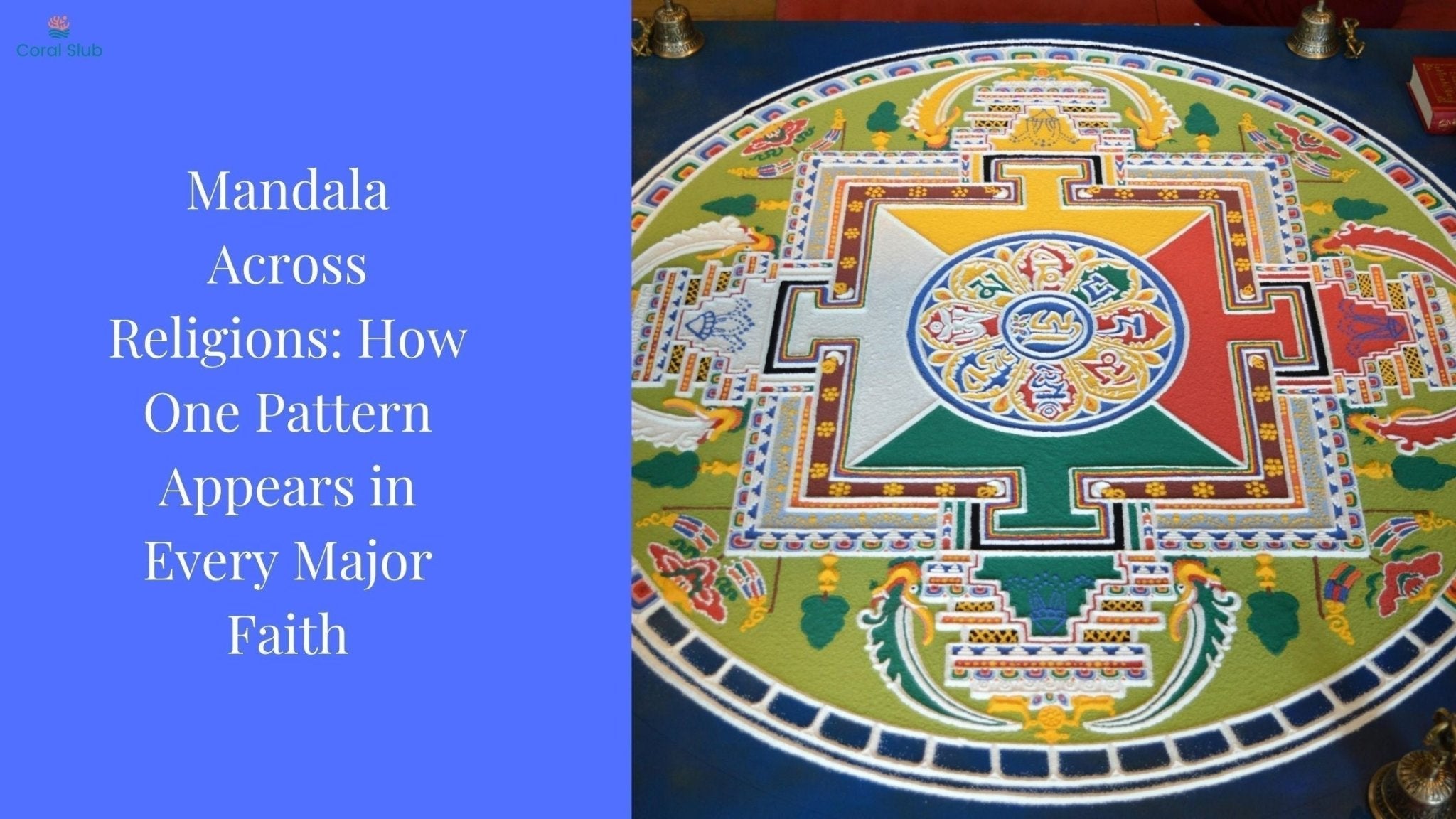
Most people associate the mandala with a single tradition, often Hindu or Buddhist.
However, a closer look reveals something far more compelling. The same radiating circular geometry appears across cultures and religions, in mosques, cathedrals, Jain temples, and Shinto shrines. It emerges independently, yet carries a remarkably consistent meaning.
This repetition is not accidental. It points to something deeper, a shared visual language that transcends geography, belief systems, and time.
The Presence of Mandala Geometry Across Traditions
A Universal Visual Structure

At its core, the mandala is defined by a central point and a symmetrical expansion outward. This structure creates a sense of order, balance, and continuity.
Across different traditions, while names and interpretations may vary, the underlying geometry remains strikingly similar. Each culture has used this form to represent the relationship between the individual and the universe, the visible and the sacred.
Mandalas in Hinduism
The Yantra as Sacred Geometry

In Hindu tradition, the mandala appears most distinctly as the yantra, a geometric instrument used in rituals, meditation, and worship.
Among these, the Sri Yantra stands as one of the most recognised forms. Composed of interlocking triangles radiating from a central point, it represents the divine in geometric form. It is not merely symbolic but is treated as a living diagram of spiritual energy.
Mandala as Architectural Foundation

Beyond ritual use, mandala principles are deeply embedded in temple architecture.
The Vastu Purusha Mandala, a sacred geometric grid, forms the blueprint for traditional temple design. From the outer boundary to the inner sanctum, every spatial layer reflects a movement toward the centre.
Entering such a temple is not just a physical experience. It is a symbolic journey inward, from the external world to a point of stillness.
Mandalas in Buddhism
The Mandala as a Meditation Tool

In Buddhist traditions, particularly Tibetan Buddhism, mandalas serve as detailed representations of spiritual realms.
They are used as visual aids for meditation, helping practitioners focus and internalise complex philosophical ideas. Painted mandalas, as well as thangkas, often depict the abode of enlightened beings, structured in concentric layers.
The Philosophy of Impermanence

The sand mandala is perhaps the most powerful expression of this tradition.
Monks spend days or even weeks creating intricate designs using coloured sand. Once completed, the mandala is deliberately dismantled and dispersed, often into flowing water.
This act is deeply symbolic. It reflects the impermanence of life and the transient nature of all things, reinforcing one of the central teachings of Buddhism.
Mandalas in Jainism
Cosmological Representation

In Jain tradition, mandalas function as precise cosmological diagrams.
The Jambudvipa mandala, for example, maps the structure of the universe as understood in Jain philosophy. It uses concentric forms to depict layers of existence, combining symbolic meaning with spatial clarity.
Sacred Space and Ritual

Mandalas in Jain practice are also used to define sacred space during rituals. They mark a boundary between the ordinary and the consecrated, creating a focused environment for worship and reflection.
Mandalas in Islamic Art
Sacred Geometry Without Figures

Islamic art does not rely on figurative representation in sacred contexts. Instead, it developed an advanced system of geometric design.
Patterns seen in mosques and palaces follow principles that closely resemble mandala structures. A central point expands outward into increasingly complex patterns, maintaining perfect symmetry.
Infinite Pattern as Divine Expression

Examples such as the Alhambra in Granada or the Sheikh Lotfollah Mosque in Isfahan demonstrate this beautifully.
These patterns are not referred to as mandalas, yet they embody the same idea. Infinite complexity emerging from simple geometry becomes a way to reflect the divine.
Mandalas in Christianity
The Rose Window as Sacred Geometry

In Gothic Christian architecture, the rose window serves as a clear parallel to the mandala.
Found in cathedrals such as Notre-Dame and Chartres, these windows feature a central focal point surrounded by concentric layers of imagery and colour.
Light, Symbolism, and Transformation

These structures were designed not only for visual beauty but for spiritual impact.
As light passes through coloured glass, the geometry becomes dynamic and immersive. The viewer is drawn into a contemplative state, much like in other mandala traditions.
Why the Same Pattern Appears Across Religions
The Mandala as a Universal Archetype

Carl Jung explored this phenomenon extensively.
He concluded that the mandala is an archetype, a form that naturally emerges from the human mind when it seeks order, integration, and meaning.
This explains why similar patterns appear across cultures that had no direct interaction. The structure is not borrowed. It was discovered.
A Shared Human Experience

At a fundamental level, the mandala represents the same idea across traditions. A centre, a surrounding world, and the relationship between the two.
It reflects a universal human experience, the search for balance within complexity.
What This Means for Modern Living Spaces
Beyond Decoration

When mandala patterns are brought into a home, they carry more than visual appeal.
They introduce a sense of structure and calm. They anchor spaces without overwhelming them. Whether used on cushion covers, table linen, or wall décor, their presence is subtle yet effective.
A Connection to Something Enduring

Unlike trend-based designs, mandalas carry historical and cultural depth.
They connect modern living spaces to centuries of meaning, making them feel more grounded and intentional.
This is what gives mandala home décor its distinct presence. It is not just styling. It is continuity.
Final Thoughts

The mandala is not confined to a single religion, culture, or era.
It appears wherever humans have sought meaning through structure. It exists wherever there is a desire to understand the relationship between the self and the universe.
That is why it continues to appear, again and again, across time and geography.
Not because it is repeated.
But because it is rediscovered.