Cart
0
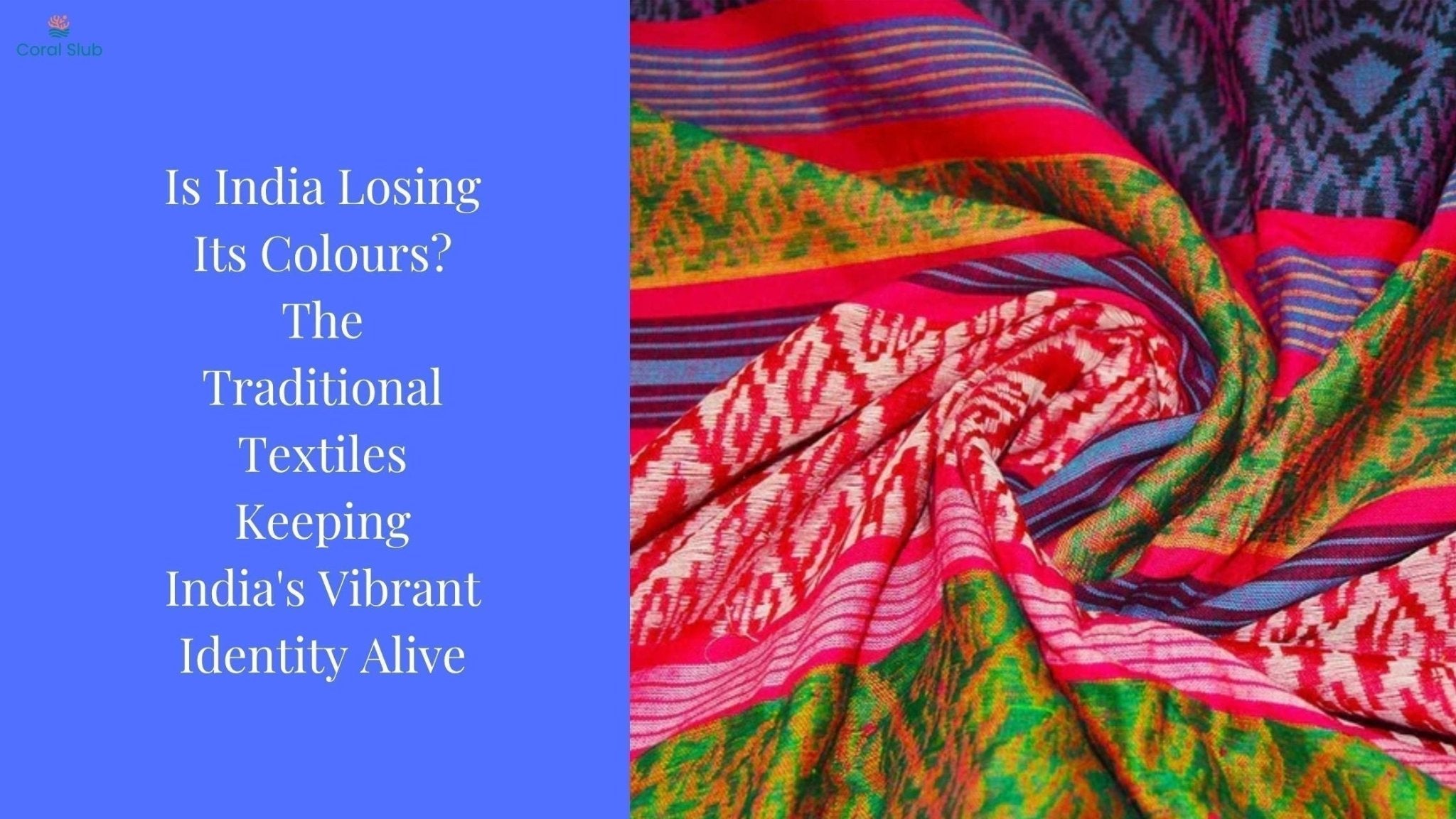
Is India Losing Its Colours?
India has never been a country that did subtle very well.Its streets have been filled with bright saris, painted trucks, colourful markets, embroidered garments, patterned textiles and homes layered with colour. From the deep indigo of Gujarat to the vivid pinks of Rajasthan, the reds of Punjab and the intricate whites of Lucknow, colour has always been an important part of how India expresses itself.
Yet somewhere between international fashion trends, minimalist interiors, celebrity wardrobes and social media aesthetics, that visual identity can sometimes feel diluted.
The problem is not that India is becoming modern. India has always evolved.The question is whether modern India is making enough space for the colours, techniques and textile traditions that have made its visual culture distinctive for centuries.Because India's colour is not simply a palette.
It is a language of craft, geography, history and identity.And across the country, artisans continue to speak that language through embroidery, weaving, dyeing and printing.
India's Colours Were Never Just About Fashion

Colour Has Always Been Connected to Place
Before trends travelled instantly through Instagram and Pinterest, textile traditions were deeply connected to geography.The materials available in a region influenced the craft. Local plants influenced dyes. Climate influenced fabrics. Communities developed techniques suited to their surroundings. Motifs reflected local architecture, nature, beliefs and everyday life.
This is why Indian textiles can often tell you where they came from.A colourful embroidered textile from Punjab does not necessarily look like one from Gujarat. A block print from Rajasthan carries a different visual language from a Kalamkari textile from Andhra Pradesh.
Every Region Developed Its Own Visual Vocabulary
India's textile diversity is remarkable because there is no single definition of what "Indian design" looks like.Instead, there are hundreds of regional languages.
Phulkari speaks through dense floral embroidery. Bandhani speaks through tiny dots created through resist dyeing. Ajrakh uses geometric precision and deep natural colours. Kalamkari transforms mythological and botanical imagery into detailed painted or printed textiles.
Together, these traditions create something much larger than individual crafts.They create the colour of India.
Phulkari: Punjab's Embroidery of Colour

When Threads Become Flowers
Few Indian textile traditions are as immediately joyful as Phulkari, the traditional embroidery associated with Punjab.The name itself refers to flower work, and floral motifs dominate many Phulkari textiles. Bright threads are worked onto fabric to create dense, rhythmic patterns that can transform an ordinary piece of cloth into something extraordinarily vibrant.
Why Phulkari Feels So Distinctly Punjabi
Phulkari has traditionally been associated with women's embroidery and important moments in life, including weddings and celebrations.The colours are bold, the motifs are expressive, and the embroidery has a sense of movement that makes the textile feel alive.
It is a reminder that embroidery does not have to be delicate or restrained.Sometimes, more colour is the point.
Bandhani: Gujarat and Rajasthan in Tiny Dots

A Textile Built from Thousands of Knots
Travel west and the visual language changes.Bandhani, also known as Bandhej, is a traditional resist-dyeing technique in which small sections of fabric are tied before dyeing. Once the threads are removed, they reveal characteristic dots and patterns.The result can be extraordinarily colourful.
From Tiny Dots to Dramatic Patterns
Bandhani textiles can feature combinations of red, yellow, green, blue, orange and other vibrant shades.The technique demonstrates how something as simple as tying and dyeing fabric can create remarkably complex visual patterns.It is one of the clearest examples of how Indian textile traditions turn technique itself into design.
Ajrakh: The Deep Colours of Kutch

Indigo, Red and Geometry
If Bandhani represents one side of western India's colour story, Ajrakh represents another.
Practised by artisan communities in the Kutch region, Ajrakh is known for its intricate geometric patterns and characteristic combinations of indigo, red, black and earthy tones.
Unlike the exuberance of some Indian textiles, Ajrakh's beauty comes from controlled repetition and balance.
Why Ajrakh Still Looks Contemporary
Its geometric vocabulary makes Ajrakh surprisingly adaptable to modern fashion and interiors.The patterns can look equally at home on traditional clothing, contemporary accessories or modern cushion covers.This is perhaps one of the most important lessons from Indian craft.Traditional does not automatically mean outdated.
Kalamkari: Stories Painted onto Fabric

When Textiles Become Storybooks
In parts of Andhra Pradesh and Telangana, Kalamkari developed as a textile tradition involving hand-painted or block-printed designs.Its imagery has historically included mythology, nature, flowers, trees, animals and narrative scenes.
A Different Kind of Colour
Kalamkari is not simply about bright colours.Its strength lies in storytelling.A single textile can contain an entire visual narrative, allowing fabric to function almost like a painting.That ability to combine art, history and everyday use is one reason Kalamkari continues to inspire contemporary textile designers.
Chikankari: The Beauty of Subtle Colour

India's Colourful Heritage Is Not Always Bright
If India is losing its colours, it is important to remember that colour does not always mean neon pinks, bright oranges or saturated blues.
Sometimes it is found in texture.Chikankari, traditionally associated with Lucknow, is a beautiful example.Its delicate embroidery is often created in white or soft shades, allowing the intricate stitches to become the primary visual element.
The Colour Is in the Craftsmanship
Chikankari demonstrates another dimension of India's textile identity.Indian design is colourful not only because of the dyes and pigments used, but because of the incredible variety of techniques used to transform fabric.The quiet elegance of Chikankari belongs to the same cultural story as the vivid colours of Bandhani.Both are Indian.Both are important.
Kantha: Stories Stitched Together

From Everyday Fabric to Art
In Bengal, Kantha embroidery has traditionally involved layers of fabric stitched together using simple running stitches.Over time, Kantha evolved into an expressive textile tradition featuring floral, geometric, figurative and narrative motifs.
Imperfection Becomes Part of the Beauty
Kantha is a powerful reminder that handmade textiles do not need to look perfectly uniform.The stitches carry the evidence of the maker's hand.The irregularities, repetitions and textures create a sense of movement that machine production struggles to replicate.It is craft with character.
Patola: Gujarat's Geometry in Colour

When the Pattern Is Created Before the Weaving
Patola, particularly the renowned double ikat tradition of Patan, represents one of India's most technically demanding textile traditions.The threads are resist-dyed before weaving so that the colours align to form intricate patterns in the finished textile.
Precision Creates Colour
The beauty of Patola comes from the extraordinary precision required to create its patterns.Geometric motifs, flowers, animals and traditional symbols appear through carefully planned colour arrangements.It is a reminder that colour can also be the result of mathematics, patience and technical mastery.
Sanganeri and Bagru: Rajasthan's Block Printing Legacy

When Woodblocks Create India's Patterns
Rajasthan has contributed enormously to India's printed textile heritage.
Sanganeri block printing, associated with Sanganer near Jaipur, is known for floral motifs, delicate patterns and colourful compositions.
Bagru printing, associated with the Bagru region, is recognised for its traditional block-printing techniques and characteristic earthy colour palettes.
The Block Is Part of the Story
Each design begins with a carved wooden block.A complex textile may require multiple blocks for different motifs or colours. The printer carefully aligns each impression across the fabric, repeating the process until the design emerges.The result is not simply a printed pattern.It is the visible record of a craft process.
Dabu: The Beauty of Resist Printing

Mud, Dye and the Art of Creating Contrast
Another important Rajasthani tradition is Dabu printing, a mud-resist technique in which parts of the fabric are protected from dye using a resist paste.When the process is completed, the protected areas create distinctive patterns against the dyed background.
Why Dabu Feels Naturally Organic
Dabu often features earthy indigos, browns, blacks and reds.Its slightly irregular appearance is part of its charm. The textile feels connected to the materials and hands involved in making it.In a world of perfectly replicated digital prints, that human variation becomes valuable.
The Real Colour of India Is Its Diversity

There Is No Single Indian Aesthetic
Perhaps this is where the conversation around India's changing visual culture needs to begin.India does not need one aesthetic.
It never had one.The country has always been a collection of contrasting colours, textures, techniques and traditions.The bright embroidery of Punjab can exist alongside the indigo geometry of Kutch. The delicate white embroidery of Lucknow can exist alongside the vibrant resist dyes of Rajasthan.
Modern India Does Not Have to Choose Between Tradition and Trend
There is nothing wrong with minimalism.There is nothing wrong with neutral interiors, quiet luxury or international fashion trends.The concern begins when every space starts looking the same.When global trends become so dominant that local craft disappears from everyday life, something valuable is lost.Not because tradition should remain frozen, but because diversity gives design meaning.
Why Indian Textile Crafts Need to Remain Visible

Craft Survives When It Is Used
Traditional crafts cannot survive through admiration alone.They need people to buy them, wear them, decorate their homes with them and pass them forward.A block-printed cushion cover becomes part of a modern living room. A Phulkari-inspired textile becomes part of a contemporary wardrobe. An Ajrakh fabric becomes a bag or a table accessory.This is how craft remains alive.
The Future of Indian Craft Can Be Contemporary
Preserving Indian textiles does not mean recreating the past exactly as it was.Artisans and designers can reinterpret traditional techniques for modern lifestyles.The motifs can change. The colour combinations can evolve. The products can become more contemporary.What matters is that the underlying craftsmanship and cultural knowledge continue.
Bringing India's Colours Back Home
 Your Home Can Become Part of the Story
One of the easiest ways to reconnect with India's textile heritage is through home décor.A colourful cushion can transform a neutral sofa. A block-printed table runner can bring pattern to a dining table. A hand-crafted textile can introduce warmth into a minimalist room without overwhelming it.
Choose Craft Over Copying
The next time you choose a textile for your home, look beyond the colour.Ask where the technique comes from. Who made it? What inspired the motif?Was it block printed, embroidered, woven or resist dyed?The answers can make an ordinary home furnishing feel much more meaningful.
India's Colours Are Still Here

We Just Need to Look for Them
Perhaps India is not actually losing its colours.Perhaps we are simply seeing fewer of them in the places that dominate our screens.
Beyond the carefully curated feeds and celebrity trends, India's textile traditions continue to thrive in artisan communities across the country.There are still hands carving wooden blocks.There are still artisans tying tiny knots into fabric.There are still embroiderers creating flowers stitch by stitch.There are still weavers working patiently at their looms.There are still colours being mixed, fabrics being dyed and patterns being printed.
The Choice Is Ours
We can allow every home, wardrobe and feed to look increasingly similar.Or we can make room for the extraordinary visual diversity that already exists around us.India's colours do not need to be rediscovered.They need to be seen, used and celebrated.
Final Thoughts

India's textile heritage is not simply a collection of beautiful crafts. It is a map of the country itself.Phulkari tells one story. Bandhani tells another. Ajrakh, Kalamkari, Chikankari, Kantha, Patola, Sanganeri, Bagru and Dabu each add another chapter.
Together, they create an India that is impossible to reduce to one trend, one colour palette or one aesthetic.Influencers and celebrities may shape what becomes fashionable for a season, but Indian craftsmanship has been shaping the country's visual identity for centuries.
The answer is not to reject modern design.It is to make sure that modern India has room for its own colours too.Because India does not need to become less colourful to become contemporary.It simply needs to remember how colourful it already is.
Bring India's Colours into Your Home with Coral Slub

Traditional Inspiration, Contemporary Living
At Coral Slub, Indian textile traditions are interpreted for modern homes through thoughtfully designed block prints, floral patterns, mandala-inspired designs, Ajrakh-inspired textiles and colourful handcrafted home décor. From vibrant cushion covers to printed table runners and other soft furnishings, each piece brings pattern, colour and craftsmanship into everyday spaces.
Let Your Home Tell a More Colourful Story
A colourful cushion, an intricate print or a beautifully patterned table runner may seem like a small design choice, but together these details can help keep India's rich textile vocabulary visible in contemporary homes.The next time you decorate your space, perhaps the most interesting trend to follow is not the one everyone else is following.It is your own Indian heritage.