Cart
0
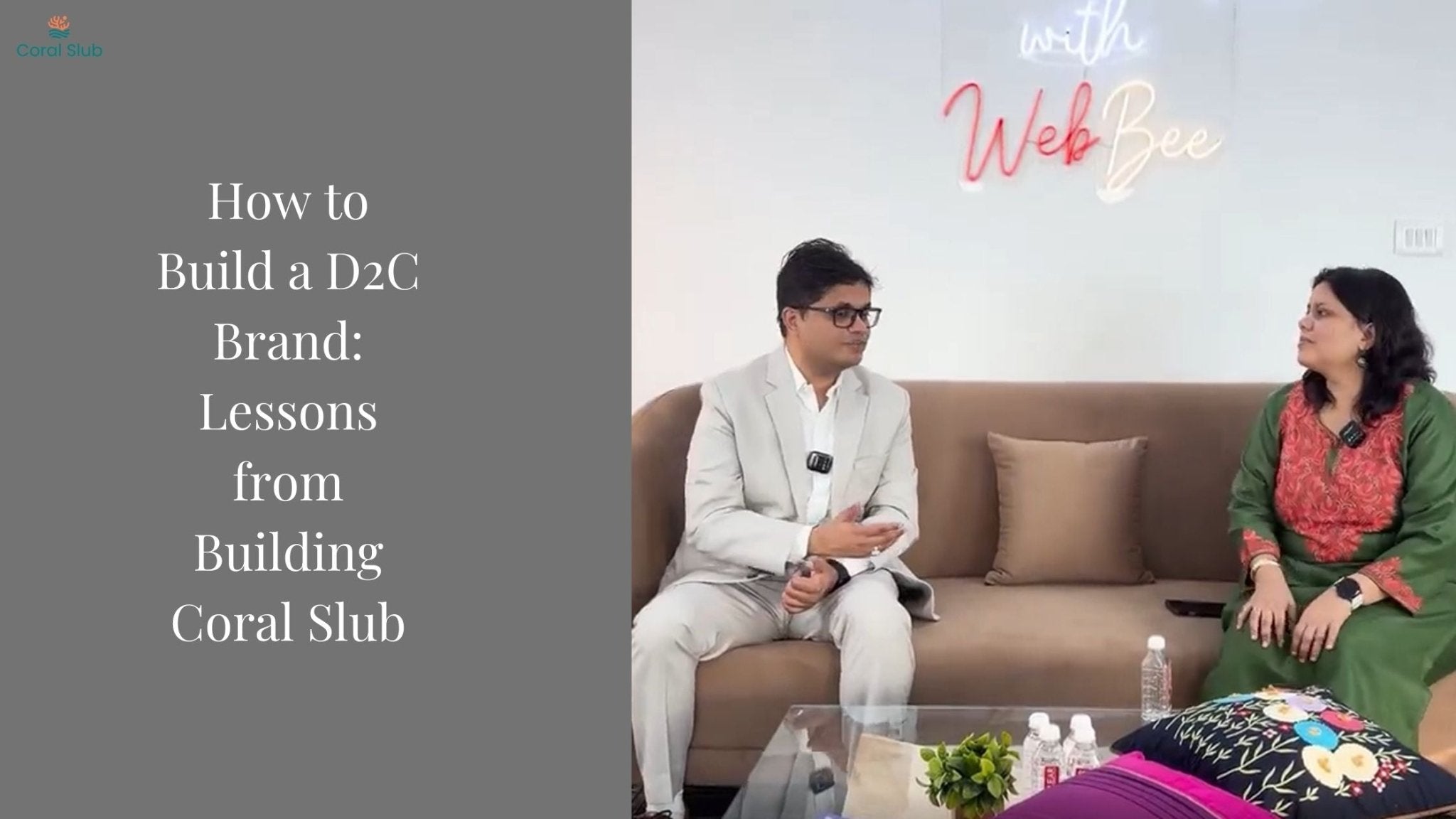
Building a D2C brand looks glamorous from the outside. Beautiful product shoots, Instagram ads, and packaging moments. But the real story of how to build a D2C brand lies in logistics, margins, customer trust, and operational discipline.
My journey from offline retail to building Coral Slub into a D2C home furnishing brand taught me that scaling a brand is less about creativity alone and more about structured thinking, financial awareness, and relentless learning.
If you are planning to build a D2C brand, here are the lessons that truly matter.
Start With Meaning, Not Just a Product

A strong D2C brand begins with clarity of identity.
When I chose the name Coral Slub, it was intentional. Coral represents organic beauty and spiritual depth. Slub refers to the technical irregularity in yarn, the beauty in non-uniformity. Together, it stood for something bigger than fabric. It stood for uniqueness and craftsmanship.
In a crowded D2C market, your brand cannot just sell products. It must stand for a philosophy. Customers today do not buy only for utility. They buy stories, identity, and emotion.
If you are building a D2C brand, start by defining what you stand for beyond your SKU list.
Bridge Design and Operations Early

One of the biggest misconceptions in D2C entrepreneurship is that branding alone drives scale.
My background at NIFT in Garment Manufacturing Technology gave me a critical advantage. Scaling requires operational clarity. Costing, procurement, production, and packaging are not backend tasks. They are the foundation.
To build a successful D2C brand, you must bridge the gap between prototype and production. A single sample is creativity. Thousands of consistent units require systems.
Design without operations fails. Operations without design becomes commodity.
Adopt the Founder’s CFO Mindset

Early in my journey, I learned the difference between vanity and sanity.
Vanity is top-line revenue. Sanity is bottom-line profitability.
When building a D2C brand, it is tempting to focus on marketing, ads, and rapid growth. But if your unit economics do not work, growth will magnify losses.
You must understand CAC, ROAS, margins, inventory turnover, and overheads. As a founder, you cannot outsource financial awareness. It defines survival.
Building a D2C brand is not just about selling. It is about sustaining.
Learn the Language of the Digital Ecosystem

Transitioning from offline retail to D2C required unlearning and relearning.
The post-2020 D2C ecosystem runs on SEO, paid ads, analytics, funnels, and performance marketing. You cannot rely only on intuition.
When I stepped into D2C, I had to learn the new vocabulary. SEO, CAC, ROAS, performance marketing. Building a D2C brand requires technical literacy in digital channels.
You may jump first and build the parachute later, but you must commit to learning continuously.
Build Trust Before You Scale

One of the defining moments in Coral Slub’s journey was what I call the “trust crisis.”
A missing refund link in the footer led a customer to believe they had been scammed. That moment taught me something critical.
Trust is built in details.
Visible policies, functional links, active social media, real product photos, and responsive communication define credibility. In D2C, customers cannot touch your product before buying. So trust replaces touch.
To build a D2C brand in India, you must obsess over transparency.
Do Not Rely Only on Paid Ads

Paid ads are powerful. But they are also fragile.
I often use a metaphor. Meta ads are like the parrot. The brand is the king’s soul inside it. If the parrot stops performing, the king collapses.
Initially, Coral Slub started on marketplaces like Amazon. Over time, the brand website became our number one sales channel. That shift was intentional.
SEO, content, and community building create long-term immunity. Paid ads drive speed. Organic channels build stability.
A healthy D2C brand balances both.
Design Experiences, Not Just Products

D2C allows you to control the entire customer journey.
We introduced what I call the Mandala Strategy. Every Coral Slub box includes a mandala colour sheet and pencils. The idea was simple. Customers are not just buying fabric. They are buying a feeling of home.
That small addition created unboxing delight, mindfulness, and user-generated content. Experience builds emotional loyalty.
In D2C, packaging is not a cost. It is a marketing asset.
Avoid the Single SKU Trap

Another critical lesson in building a D2C brand is inventory strategy.
If you advertise one entry-level SKU and it goes out of stock, customers may feel misled. Offering alternatives at similar price points prevents trust erosion.
Inventory management is expectation management.
Scaling D2C means thinking beyond design to assortment planning.
Educate Your Customers Proactively

In one instance, customers received vacuum-packed fillers and thought they were flat or defective. Clear instructions and direct communication solved the confusion.
In D2C, education reduces friction.
Explain materials. Explain care. Explain packaging. The more informed the customer, the lower the returns and complaints.
The 23.5 Hour Rule of Entrepreneurship

Entrepreneurship is not constant motivation.
There will be moments of fear and doubt. But for me, those moments last only half an hour. The remaining 23.5 hours are about the joy of building.
Self-belief is not optional in D2C. It is foundational.
Final Takeaways on How to Build a D2C Brand

Building a D2C brand is not about quick growth hacks. It is about:
-
Strong operational foundations
-
Financial discipline
-
Customer trust
-
Balanced marketing strategy
-
Experience-led differentiation
-
Inventory planning
-
Continuous learning
My vision with Coral Slub has always been to build India’s favourite home furnishing brand while maintaining the soul of a startup.
If you are building your D2C brand today, remember this. Trends change. Platforms change. Algorithms change.
But trust, clarity, and conviction remain constant.
Build for the long term.
For a deeper discussion on these lessons and the journey of building Coral Slub as a D2C brand, watch the full YouTube podcast here: https://youtu.be/Mp0CCsIGIqo?si=QTv8bbEPreoTAG8s