Cart
0
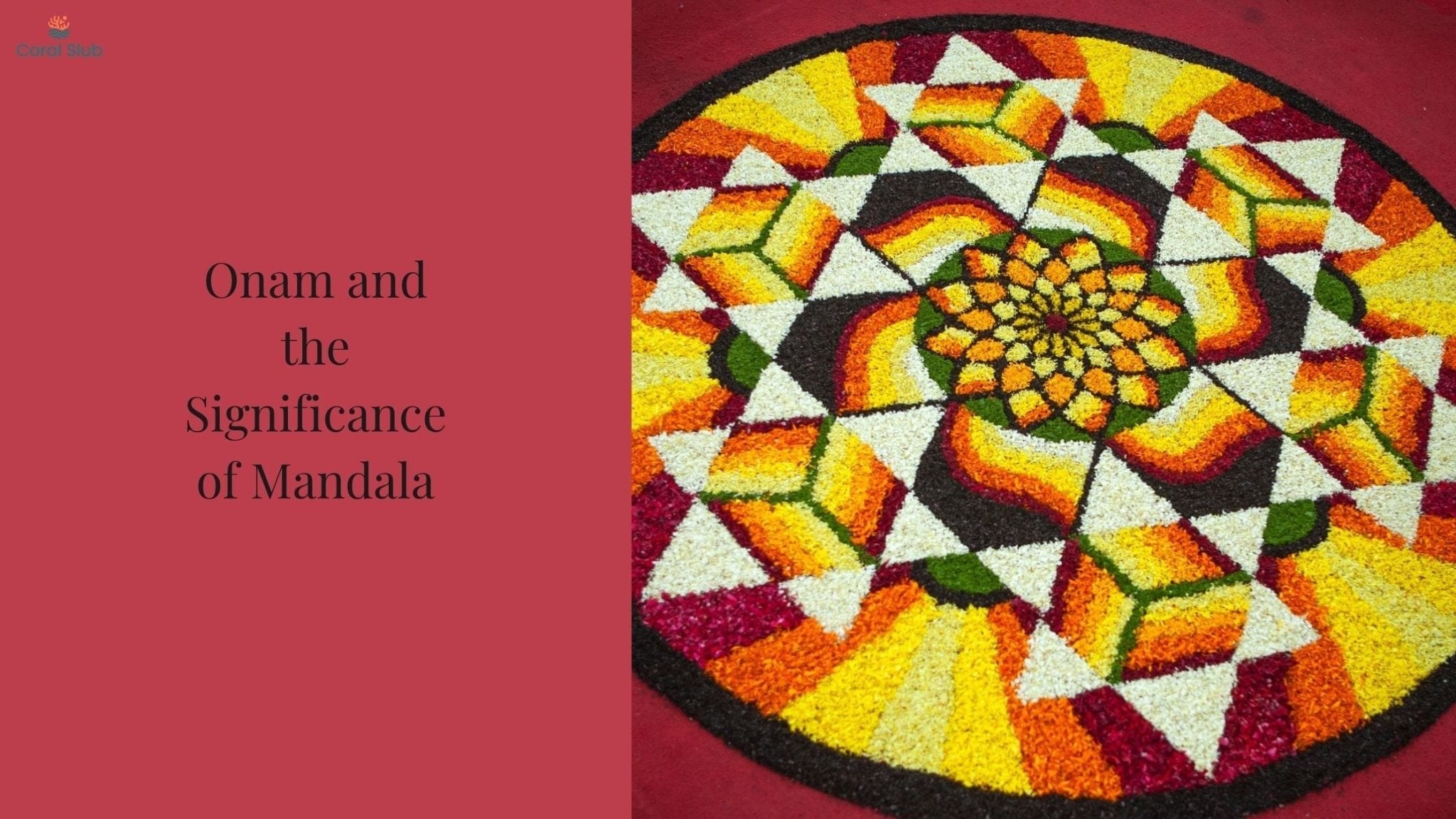
Onam is often recognised through its most familiar traditions: the colourful Pookkalam, the elaborate Onasadya, traditional clothing, Vallamkali, music, dance, and the welcoming spirit associated with King Mahabali.
But look closely at the floral designs created during the festival and another visual idea begins to emerge: the mandala.
The circular structure, symmetry, repetition, and carefully arranged floral patterns found in many festive designs have a natural connection with the visual language of mandalas. While a Pookkalam is a distinct Kerala tradition and should not simply be equated with a mandala, both use balance, circularity, repetition, and geometric order to create meaningful visual spaces.
This makes the mandala an interesting lens through which to understand Onam. It allows us to look beyond decoration and explore ideas of harmony, abundance, togetherness, renewal, and balance that resonate strongly with the festival.
What Is a Mandala?
 Understanding the Circle at the Centre
The word mandala comes from Sanskrit and is commonly associated with a circle. In Indian religious and philosophical traditions, mandalas can represent wholeness, cosmic order, balance, and the relationship between the centre and the world surrounding it.
A typical mandala begins from a central point and expands outward through symmetrical shapes, circles, geometric forms, or floral elements.
Why Is Symmetry Important?
Symmetry creates a sense of visual balance.When one element is repeated around a central point, the design feels ordered and complete. This quality is one reason mandala patterns are often associated with meditation, contemplation, and harmony.
The symbolism varies according to the specific tradition and design, so a mandala does not have one universal meaning. However, ideas of wholeness, balance, interconnectedness, and order are commonly associated with mandala imagery.
Is a Pookkalam a Mandala?

Understanding the Difference
A Pookkalam and a mandala are not the same thing.A Pookkalam is a traditional Kerala floral decoration created during Onam, generally using fresh flowers arranged in patterns on the ground. Its primary cultural context is the celebration of Onam and the traditional welcome associated with King Mahabali.
A mandala, meanwhile, is a broader symbolic and artistic concept found across several Indian and Asian traditions.
Why Do They Look Similar?
The visual connection comes from their use of circular compositions, symmetry, repetition, radial patterns, and a central focus.
Many Pookkalam designs begin from the centre and develop outward in concentric layers. Flowers of different colours are arranged carefully to create geometric and floral patterns.
This creates a mandala-like visual effect, even though the Pookkalam has its own distinct cultural identity.
The Significance of Circular Patterns During Onam

A Celebration of Continuity
The circle is one of the most recognisable features of both mandala-inspired designs and many Pookkalam patterns.
A circle has no obvious beginning or end, making it a natural visual representation of continuity and wholeness.
This idea resonates with Onam's emphasis on returning, gathering, and renewal.According to the traditional Mahabali legend, the king returns to visit his people each year. The recurring cycle of Onam itself creates a connection between past and present, with families returning to familiar traditions year after year.
From One Generation to the Next
The same traditions are repeated across generations.Children learn to make Pookkalam from parents and grandparents. Families gather around the Onasadya. Traditional games, clothing, songs, and celebrations are passed down.
In this sense, the circular form can serve as a visual metaphor for the continuity of cultural traditions.
Mandala and the Idea of Abundance

Why Floral Patterns Feel So Appropriate for Onam
Onam is closely connected with Kerala's agricultural traditions and the idea of abundance.The festival arrives during the Malayalam month of Chingam, a period associated with the agricultural cycle and harvest. The abundance of flowers, fresh produce, and food becomes part of the celebration.The mandala's expanding structure complements this idea beautifully.
From a Single Point to a Complete Design
A mandala often begins with a central point and gradually expands outward.This visual movement can be interpreted as a metaphor for growth: one element becoming many, a small beginning developing into something complete.Similarly, the Pookkalam grows throughout the Onam period, with additional flowers and layers creating an increasingly elaborate design.
The visual language of expansion therefore fits naturally with the festive themes of growth, prosperity, and abundance.
The Centre of the Mandala and the Heart of Onam

Bringing Everything Together
A mandala usually has a central point around which the rest of the design develops.This central focus creates a sense of order. Every surrounding element relates back to the centre.
Onam celebrations also have their own centre of togetherness.For many families, that centre is the home.For others, it is the family gathering, the Pookkalam, the festive meal, or the shared celebration that brings everyone together.
A Festival Built Around Togetherness
The traditional Onasadya is a particularly strong example.People sit together and share a meal, with numerous dishes coming together as one complete feast. Individual elements may be different, but collectively they create the Sadya.This idea of individual elements becoming part of a larger whole closely echoes the visual structure of a mandala.
The Role of Colour in Onam and Mandala Designs

Creating a Sense of Joy and Balance
Colour is central to both festive Pookkalam designs and many mandala-inspired patterns.Bright yellows, oranges, whites, pinks, reds, purples, and greens create a vibrant visual experience.During Onam, these colours reflect the richness of nature and the celebratory mood of the festival.
Colour as More Than Decoration
The arrangement of colour also creates rhythm.Alternating shades, repeating patterns, and concentric layers allow the eye to move naturally through the design. The result is visually balanced despite the richness of colours.This is one of the reasons floral decorations can feel both elaborate and harmonious at the same time.
Mandala and the Spirit of Renewal
A Visual Expression of New Beginnings

Onam arrives at a significant point in Kerala's annual cycle.The festival is associated with harvest, prosperity, family gatherings, and the return of Mahabali. It is therefore a celebration of renewal as much as remembrance.
Mandala symbolism also lends itself to ideas of cycles and renewal.The circular structure suggests continuity rather than a fixed endpoint. When used as inspiration for festive décor, it can represent the idea of returning to what matters while creating something new each year.
Bringing Mandala-Inspired Décor into an Onam Home

From the Pookkalam to Contemporary Interiors
The beauty of mandala-inspired design is that its visual language can move beyond the floor.In a contemporary home, circular and symmetrical motifs can appear through textiles, artwork, cushions, table runners, wall décor, and other furnishings.The key is to use the motif thoughtfully rather than filling the entire room with patterns.
Keep the Rest of the Space Simple
A mandala-inspired cushion on a neutral sofa can become a subtle focal point.Similarly, a patterned table runner can introduce symmetry and colour to an Onam dining setup without competing with the traditional Sadya.Natural materials such as cotton, wood, brass, ceramics, and fresh flowers complement these patterns particularly well.
Mandala-Inspired Textiles for Onam
Connecting Craft, Pattern and Celebration

Indian textile traditions have long drawn inspiration from geometry, nature, spirituality, and architecture.Mandala-inspired motifs therefore fit naturally into contemporary Indian home décor.
A cushion cover featuring a balanced circular pattern can bring visual harmony to a living room, while handcrafted cotton textiles add the tactile quality associated with traditional Indian craftsmanship.During Onam, these textiles can work alongside a Pookkalam and traditional festive elements, creating a home that feels connected to the celebration without becoming overly decorated.
Why Mandala Still Matters in Modern Homes
Ancient Visual Language, Contemporary Living
One reason mandala patterns continue to appear in modern interiors is their ability to balance complexity and order.A detailed mandala can contain numerous shapes and colours, yet its symmetry gives the overall design a sense of structure.This makes it particularly useful in contemporary décor, where homeowners often want to introduce pattern and colour without creating visual chaos.
For a festival such as Onam, it provides an opportunity to connect traditional symbolism with modern aesthetics.
Final Thoughts

The relationship between Onam and mandala is best understood through shared visual and symbolic ideas rather than as a direct historical connection between the two traditions.
A Pookkalam is uniquely rooted in Kerala's Onam celebrations, while the mandala represents a much broader symbolic tradition associated with circularity, balance, wholeness, and interconnectedness.Yet when we look at the concentric floral patterns of a Pookkalam, the connection becomes visually compelling. Both invite us to think about the relationship between the centre and everything around it, between individual elements and the complete design, and between tradition and the generations that carry it forward.
Perhaps that is what makes mandala-inspired décor so fitting for Onam. The festival itself is about bringing people together, celebrating abundance, remembering heritage, and returning to traditions that connect one generation with another.Like a mandala, Onam brings many individual elements together to create something greater than the sum of its parts.