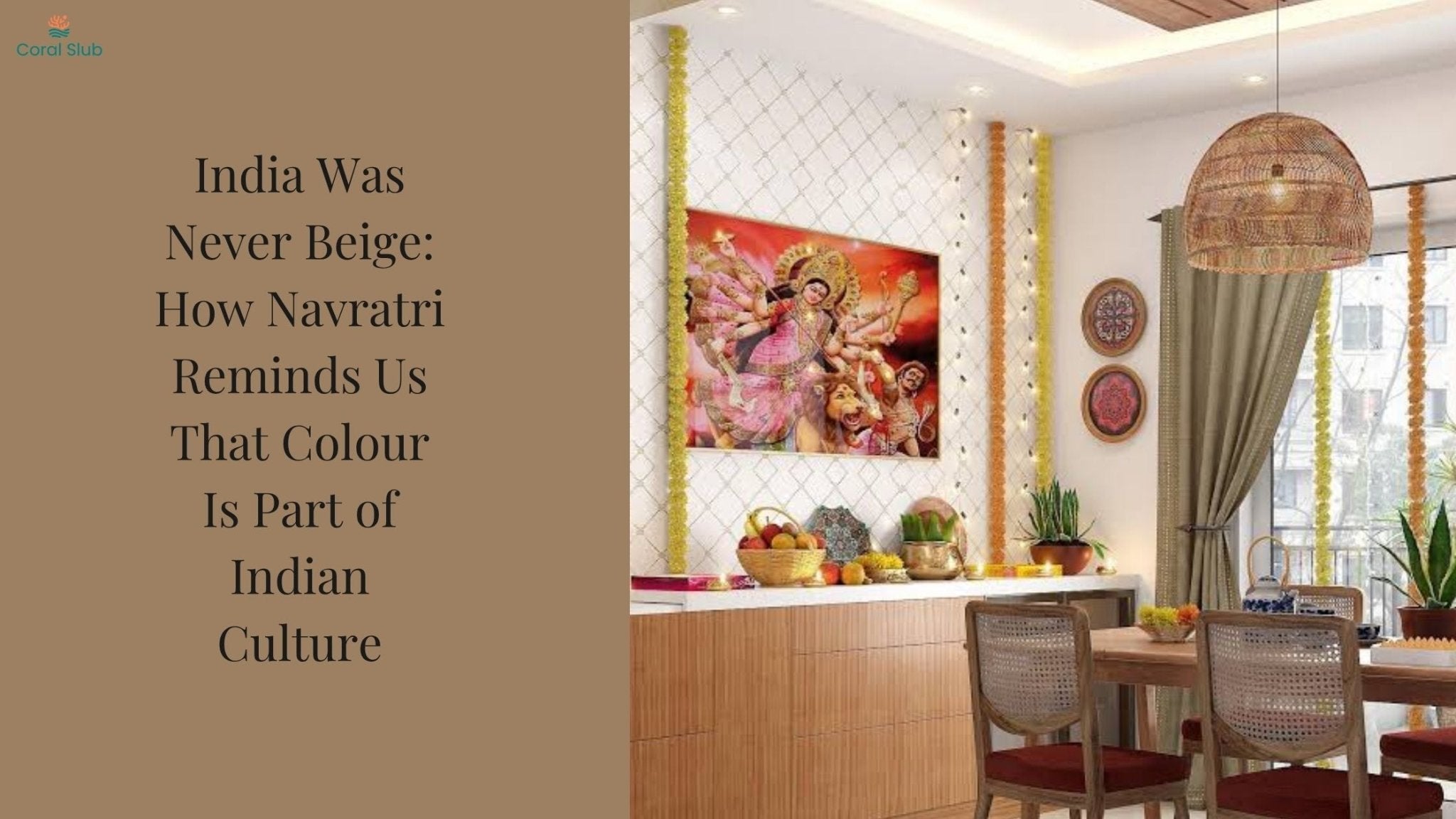
Walk into a home décor store today, scroll through an interior design feed or browse a contemporary home collection, and you may notice a familiar palette: beige sofas, cream walls, muted cushions, warm whites and soft greys. Minimalism has become a defining aesthetic of modern interiors, with neutral colours often associated with sophistication, calm and timeless design. While there is nothing wrong with loving a neutral home, it raises an interesting question: when did we begin to think of colour as something that needs to be toned down?
Look at India during Navratri, and the answer becomes far more interesting. Streets fill with vibrant decorations, Garba grounds come alive with mirror work and colourful chaniya cholis, homes welcome the goddess with flowers and traditional fabrics, and the nine-day festival inspires people to dress in different colours. Red, orange, yellow, green, blue, pink and purple appear across clothing, textiles, decorations and celebrations. Colour is not simply an accessory to the festival. It is woven into the way people express devotion, celebrate community and connect with their cultural identities.
Perhaps this is why the idea that India was ever meant to be beige feels so far removed from the country's cultural imagination. From the colours of its festivals to the patterns of its textiles, India has long embraced visual richness. Navratri offers a timely reminder that colour is not merely a design trend. It is a language through which we express who we are.
Why Is Everyone Choosing Beige?
The Rise of Neutral Interiors
Beige has become a familiar presence in contemporary interiors. It works beautifully with natural materials, creates a sense of visual continuity and allows architectural details to stand out. Cream, taupe, ivory and other neutrals can make a room feel calm and considered, which explains their popularity across modern homes.
When Minimalism Becomes the Only Definition of Good Taste
The problem is not the colour itself. The problem begins when a particular aesthetic becomes the only definition of good taste. When every sofa, cushion, rug and bedsheet is expected to follow the same restrained palette, the possibilities of colour and pattern can begin to feel less desirable. A room that could express a family's personality may instead become a carefully coordinated collection of neutrals.
India's cultural traditions offer a different perspective. Our visual heritage is full of bold contrasts, elaborate patterns, decorative borders, richly coloured fabrics and intricate surface details. Indian design has never depended on one universal palette. It has evolved through regional craft traditions, local materials, historical exchanges, religious practices and the creativity of artisans.
The answer is not to reject beige or abandon minimalism. It is to recognise that neutral interiors are one aesthetic among many, not a standard that every Indian home must follow.
Navratri: Nine Days That Celebrate the Power of Colour
The Cultural Significance of Navratri
Navratri provides one of the clearest examples of the relationship between colour and Indian cultural expression. Dedicated to the worship of Goddess Durga and her different forms, Sharad Navratri is observed across India through prayers, fasting, music, dance and regional traditions.
In Gujarat, Garba and Dandiya bring communities together through movement, music and colourful festive clothing. In eastern India, Durga Puja transforms public spaces through elaborate pandals, artistic installations and ceremonial celebrations. Other regions observe the festival through devotional gatherings, household rituals and traditional displays.
Why Are Nine Colours Associated with Navratri?
The popular tradition of assigning a colour to each of the nine days has also become a familiar part of contemporary Navratri celebrations. People often coordinate their outfits, accessories and even their festive decorations with the colour associated with that day's observance. The precise colour sequence can vary across published calendars and regional customs, but the broader visual effect is unmistakable: Navratri creates space for colour to be celebrated openly and collectively.
During Navratri, nobody needs to explain why a bright red dupatta, a vibrant green chaniya choli or a colourful arrangement of flowers belongs. The colours are part of the occasion, the emotion and the experience. They are not necessarily there to match everything else. They are there to mean something.
What Do Colours Mean in Indian Culture?
Colours in India carry layers of meaning shaped by religion, regional customs, textiles, rituals and everyday experiences. Their significance is not fixed across every community, and the same colour can express different ideas in different contexts. Yet certain associations recur throughout Indian cultural life, making colour an important part of how traditions are experienced and remembered.
Red:
Red has a prominent place in many Indian festivals, wedding traditions and religious ceremonies. It is often associated with auspiciousness, energy, strength and the divine feminine. Red flowers, vermilion, festive garments and decorative details appear in numerous forms of worship and celebration.
During Navratri, red can evoke the powerful and protective aspects of Goddess Durga. It also appears in traditional Indian textiles, from richly coloured embroidered fabrics to printed cottons and festive drapes. A red cushion cover on a neutral sofa, a patterned textile on a dining table or a few carefully chosen festive accents can introduce warmth and character without overwhelming the space.
Yellow:
Yellow brings together several familiar elements of Indian life. It appears in turmeric, mustard flowers, marigolds, traditional garments and festive decorations. In many communities, it is associated with auspiciousness, prosperity, warmth and new beginnings.
Its connection with turmeric is particularly meaningful because haldi features in a range of Indian rituals and celebrations. Yellow marigold garlands, printed cushion covers and table accents can brighten a room without requiring a complete redesign. The colour feels especially inviting when combined with natural wood, cotton textiles and other earthy materials.
Green:
Green is often associated with nature, fertility, growth and renewal. Across India's agricultural landscapes, the colour evokes crops, foliage and the changing seasons. It also appears in traditional clothing, jewellery, regional embroidery and festive decorations.
A printed green cushion, a patterned table runner or a combination of green textiles and fresh foliage can create a connection between the home and the natural world. Green demonstrates that colour does not have to be loud to be expressive. It can be grounding, refreshing and deeply connected to the environment around us.
Blue and Indigo:
Blue offers an especially interesting connection between Indian textile heritage and the wider history of colour. Indigo, a deep blue dye traditionally obtained from plants, has a long history of use in textile traditions across the world, including India. The English word indigo traces its linguistic roots through Latin to the Greek indikon, meaning an Indian or Indian-derived dye.
This etymology is a reminder of the historical importance of India in the story of textile dyes and global trade. Indigo block prints, blue patterned cushion covers and traditional textile motifs can bring visual depth to a room while celebrating the connection between colour, craftsmanship and the movement of materials and ideas across cultures.
Orange:
Orange is a familiar sight during Navratri and other Indian festivals. It appears in marigold decorations, devotional flags, traditional clothing and ceremonial arrangements. It is often associated with energy, enthusiasm, spiritual commitment and the warmth of celebration.
Orange also illustrates how colour can influence the mood of a space. Even a single bright accent can make a room feel more animated and welcoming, especially when balanced with natural materials and complementary shades.
Garba: Where Colour Becomes a Shared Experience
More Than Just Festive Clothing
To understand India's relationship with colour, look beyond the colour charts and into a Garba celebration.
As the music begins, people move in circles, clapping and dancing to the rhythm. Traditional outfits feature colourful fabrics, mirror work, embroidery, decorative borders and swirling silhouettes. Participants of different ages come together, from young children learning the steps to older generations who have celebrated the festival for decades.
How Garba Reflects India's Cultural Identity
There is no single colour palette that defines every Garba celebration. Instead, the visual energy comes from the combination of individual expression and shared participation. Each outfit has its own character, yet all of them contribute to the larger spectacle.
This is what makes Garba such a compelling example of colour as culture. Colour becomes part of movement, music, identity and community. The textiles catch the light, the patterns shift as people dance, and the entire setting becomes an expression of collective joy.
The same principle can apply to the home. A beautiful interior does not always need every element to match perfectly. Sometimes, the most interesting spaces are those where different colours, textures and patterns come together in a way that feels personal and natural.
Indian Textiles Have Always Made Room for Colour
Rajasthan:
India's relationship with colour extends far beyond festivals. Rajasthan is known for colourful block printing and tie-dye traditions, where repeated motifs and vibrant shades bring fabric to life. These textiles can introduce pattern and character into contemporary interiors through cushion covers, table runners and other home furnishings.
Gujarat:
Gujarat's Bandhani and Patola textiles demonstrate the visual possibilities of resist-dyeing and intricate weaving. Their patterns reflect regional craftsmanship and the skill required to produce detailed, carefully composed designs.
Bengal:
Bengal's Kantha embroidery brings texture and storytelling into fabric. The rhythmic stitching and decorative motifs demonstrate how textile traditions can combine practical techniques with creative expression.
Punjab:
Punjab's Phulkari is recognised for its vibrant embroidery. The use of colourful threads and geometric or floral motifs gives these textiles a distinctive visual identity, illustrating how embroidery can become an expression of cultural pride and celebration.
Traditional Crafts in Contemporary Homes
These traditions are not identical, and their histories cannot be reduced to a single idea of Indian design. Each has developed through specific materials, communities, techniques and cultural influences. Together, however, they challenge the assumption that sophistication must always be restrained or that traditional design must be simplified to fit contemporary tastes.
A block-printed cushion cover can become the focal point of a sofa. A richly patterned table runner can bring personality to a dining space. An embroidered textile can add detail and depth to an otherwise simple room. The important thing is not to fill every corner with colour. It is to give colour the opportunity to contribute to the character of a space.
Why Should Indian Homes Embrace Colour Beyond Festivals?
Colour as an Expression of Personal Identity
Festivals provide a natural opportunity to bring colour into the home, but there is no reason for its presence to end when the celebrations do. Colour can be part of everyday living, reflecting personal preferences, family memories and the things that make a space feel like home.
Start Small with Colourful Home Textiles
For those who prefer neutral interiors, the transition can begin with small details. Printed cushion covers can introduce a favourite colour without changing the sofa. A table runner can add pattern to a dining table. Bedsheets can bring a fresh mood to the bedroom, while decorative textiles can make a familiar room feel different from one season to another.
Create Balance Between Neutrals and Bold Prints
The advantage of using textiles is their flexibility. Unlike permanent architectural changes, cushion covers and table linen can be changed, layered or stored according to the occasion. A neutral sofa can look entirely different when paired with deep red, indigo, mustard yellow or green cushions. A dining table can feel more festive with a printed runner and fresh flowers.
Colour does not have to mean clutter. The key is to create a balance between the pieces that provide visual calm and the pieces that express personality. A home can have both.
Bringing the Spirit of Navratri into Your Home with Coral Slub
Add Colour Through Cushion Covers
At Coral Slub, colour and Indian-inspired textile design offer a way to make everyday spaces feel more individual. A set of colourful printed cushion covers can add character to a neutral sofa, while embroidered details can bring texture to a quieter palette.
Style Your Dining Space with Printed Table Runners
A printed table runner can make everyday dining feel more welcoming. Choose colours that complement your existing tableware and furnishings to introduce a festive touch without making the space feel crowded.
Dussehra, Navratri and the Story of Akal Bodhan
Why Does Dussehra Follow Navratri?
There is another reason the Navratri season invites us to think about cultural identity. The festival is followed by Vijayadashami, widely known as Dussehra in many parts of India, although the specific rituals and narratives associated with the occasion differ across regions.
In many traditions, Dussehra marks the victory of good over evil. In parts of North India, the occasion is associated with the story of Lord Rama's victory over Ravana. In Bengal, the autumn worship of Goddess Durga is connected with the story of her victory over Mahishasura. These narratives give the season a powerful sense of renewal, courage and the triumph of righteousness.
What Is Akal Bodhan?
A related story, particularly prominent in the Bengali tradition, is known as Akal Bodhan, meaning the invocation or awakening of the goddess at an unusual time. According to the Krittivasi Ramayana, a Bengali retelling of the epic, Lord Rama sought the blessings of Goddess Durga before his battle with Ravana. As the traditional time for her special worship was associated with spring, Rama's autumn invocation became known as Akal Bodhan.
The Story of the 108 Blue Lotuses
In this account, Rama undertakes to offer 108 blue lotuses to the goddess. When he discovers that one lotus is missing, he prepares to offer one of his own eyes, traditionally associated with his lotus-like eyes. Before he can do so, Goddess Durga appears and blesses him with victory. This story belongs to a particular devotional and literary tradition; it does not appear in the same form in the Valmiki Ramayana.
India Was Never Beige
Colour as a Part of India's Cultural Identity
India's cultural identity cannot be captured by one colour, one aesthetic or one style of design. It is expressed through a remarkable diversity of languages, crafts, textiles, rituals, landscapes and ways of living. Colour is one of the threads that connects many of these expressions, from the deep blue of indigo-dyed fabric to the bright shades of festive clothing and the intricate patterns of traditional prints.
Navratri brings this relationship into focus. It shows how colour can express devotion, create a sense of belonging, celebrate craftsmanship and bring people together. It also reminds us that the beauty of Indian design lies not in following a single rule, but in the freedom to combine tradition with individual expression.
A Home Can Be Neutral and Still Celebrate Colour
You can love beige. You can choose a neutral sofa, cream walls or a minimalist bedroom. But you do not have to leave colour, pattern and cultural heritage outside the door to create a sophisticated home.
Perhaps the better approach is to make room for both: the calm of a neutral backdrop and the character of a colourful textile, the simplicity of modern furniture and the richness of a traditional print.
Because India was never defined by beige alone. Its cultural story has always had room for many colours, and our homes can reflect that same richness.